
Introduction
If you’ve ever submitted paperwork to a court, immigration office, or foreign university, you’ve probably run into a confusing requirement: “certified translation only.” But what does that actually mean, and how is it different from regular legal translation?
Understanding this distinction matters more than most people realize. Submit the wrong type of document, and you could face delays, rejections, or even legal complications.
In this guide, we’ll break down exactly what separates certified legal translation from non-certified legal translation, when you need each one, and how to avoid costly mistakes.
Table of Contents
- What Is Legal Translation?
- What Makes a Translation “Certified”?
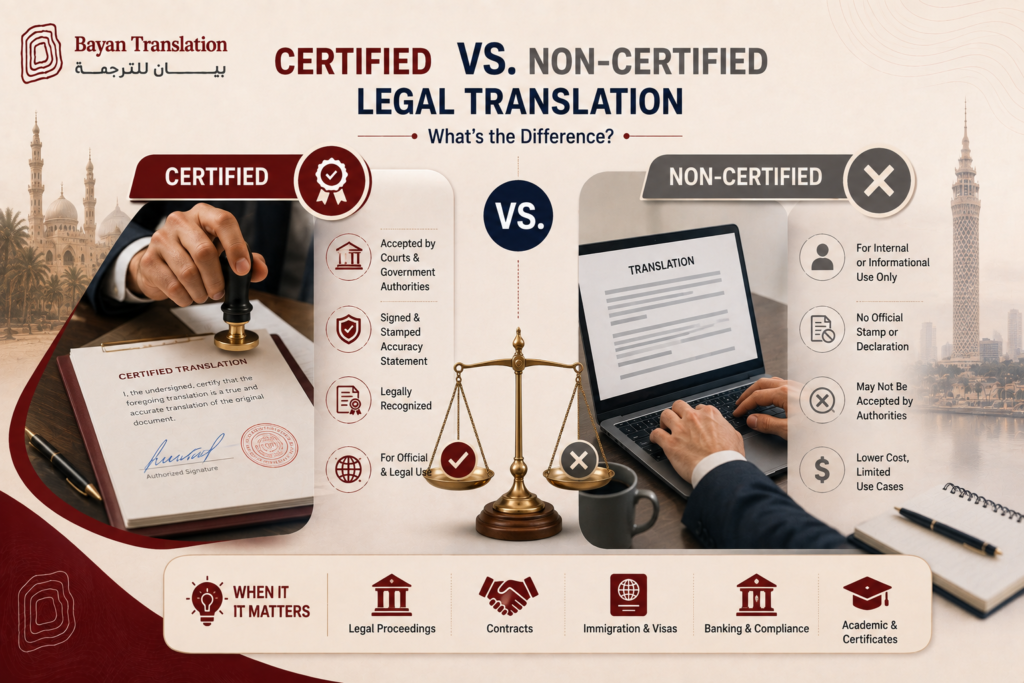
- Certified vs. Non-Certified Legal Translation: Key Differences
- When Do You Need Certified Legal Translation?
- When Non-Certified Legal Translation Is Enough
- How to Choose the Right Type
- Common Mistakes to Avoid
- FAQs
What Is Legal Translation?
Legal translation is the process of converting legal documents from one language into another while preserving their exact meaning, tone, and legal effect.
This isn’t like translating a blog post or a menu. A single mistranslated term in a contract can shift liability, void an agreement, or change the outcome of a court case.
Common documents that require legal translation include:
- Contracts and agreements
- Court rulings and pleadings
- Immigration documents
- Powers of attorney
- Wills and estate documents
- Corporate bylaws and compliance filings
Because the stakes are high, legal translation demands more than fluency. It requires a deep understanding of legal terminology, jurisdictional differences, and the exact phrasing that carries weight in each legal system.
What Makes a Translation “Certified”?
A certified translation is a translation accompanied by a signed statement from the translator or translation agency confirming that it’s a complete and accurate rendering of the original document.
This signed statement is called a Certificate of Accuracy. It typically includes:
- The translator’s name and qualifications
- A declaration of accuracy and completeness
- The date of translation
- A signature, and sometimes a stamp or seal
Certification doesn’t mean the translator is a notary or government official. It simply means they’re formally vouching for the quality and accuracy of the work, and taking professional responsibility for it.
Certified vs. Notarized: A Quick Clarification
People often confuse these two terms. Certification confirms accuracy. Notarization confirms identity, a notary public verifies that the person signing the certificate is who they claim to be.
Some situations require both. Others require only certification. Always check with the receiving institution before assuming.
Certified vs. Non-Certified Legal Translation: Key Differences
Here’s where the two paths really diverge.
| Factor | Certified Legal Translation | Non-Certified Legal Translation |
| Legal validity | Accepted by courts, USCIS, universities | Often not accepted for official use |
| Accountability | Signed statement of accuracy | No formal accountability |
| Cost | Slightly higher | Generally lower |
| Turnaround | Standard to moderate | Often faster |
| Use case | Official, legal, or governmental submissions | Internal review, informal use |
Accuracy Standards
Both types aim for accuracy, but certified translation carries a formal, documented guarantee. If an error is found, the certifying translator or agency is professionally accountable.
Legal Recognition
This is the biggest difference. Government agencies, courts, and academic institutions typically require certified translation because it comes with a paper trail of accountability.
Non-certified translation, while sometimes perfectly accurate, lacks that official backing. It’s essentially the word of the translator with nothing formal attached.
Purpose and Use Cases
Non-certified legal translation still has its place. Law firms often use it for internal review, due diligence, or understanding foreign contracts before deciding whether formal certification is necessary.
When Do You Need Certified Legal Translation?
You’ll almost always need certified translation when submitting documents to:
- Immigration authorities – visa applications, green card petitions, citizenship paperwork
- Courts – evidence, pleadings, judgments from foreign jurisdictions
- Universities – transcripts, diplomas, academic records for foreign students
- Government agencies – vital records like birth, marriage, or death certificates
- Corporate and regulatory bodies – official filings, licensing documents, compliance paperwork
If a document affects your legal status, rights, or eligibility, assume certification is required unless told otherwise.
When Non-Certified Legal Translation Is Enough
Not every legal document needs the certification stamp. Non-certified translation works well for:
- Internal business reviews of foreign contracts
- Preliminary research before litigation
- Draft agreements not yet finalized
- Personal understanding of legal correspondence
Basically, if the document isn’t being submitted to an official body, you likely don’t need certification, though it never hurts to double-check.
How to Choose the Right Type
Ask yourself these three questions before ordering a translation:
- Who is receiving the document? Government agencies almost always require certification.
- What’s the document’s purpose? Legal proceedings and official submissions need certified translation; internal use often doesn’t.
- Does the receiving party have specific requirements? Some institutions also demand notarization or an apostille on top of certification.
When in doubt, ask the receiving institution directly, or consult a professional translation provider who works with these requirements regularly.
Common Mistakes to Avoid
Even experienced applicants trip up on a few recurring issues:
- Assuming any bilingual translation works. Fluency alone doesn’t equal legal accuracy or formal certification.
- Skipping certification to save money. Rejected documents often cost more in delays than certification would have upfront.
- Ignoring formatting requirements. Many agencies require certified translations to mirror the original document’s layout.
- Using machine translation for official submissions. Automated tools cannot provide certification and frequently misinterpret legal terminology.
FAQs
1. Is certified legal translation the same as sworn translation? Not always. In some countries, “sworn translation” refers to translations done by a court-appointed translator with special legal authority. Certified translation is a broader term used mainly in the U.S. and similar systems.
2. How much does certified legal translation cost? Pricing varies by language pair, document length, and turnaround time. Certified translation typically costs somewhat more than non-certified work due to the added accountability and formal certificate.
3. Can I certify my own translation? Generally, no. Most institutions require certification from a professional translator or agency, not the document owner, since self-certification defeats the purpose of independent verification.
4. Do certified translations need to be notarized too? Sometimes. It depends on the receiving institution. Courts and immigration offices may require notarization in addition to certification, while others accept certification alone.
5. How long does certified legal translation take? Turnaround depends on document length and complexity, but standard certified translations often take a few business days. Rush options are usually available for urgent submissions.
6. What happens if I submit a non-certified translation when certification was required? Your document will likely be rejected, causing delays in your application, case, or enrollment process. It’s always safer to confirm requirements beforehand.
7. Can certified legal translation be used internationally? It depends on the country. Some nations require additional steps like an apostille or embassy legalization alongside certification for international recognition.
Choosing between certified and non-certified legal translation isn’t just a formality, it can determine whether your documents are accepted or rejected outright. Certified legal translation offers the accountability and official recognition that courts, immigration offices, and institutions require, while non-certified translation suits internal or informal purposes.
When your documents carry legal weight, certification isn’t optional. It’s the difference between a smooth process and a costly delay.
Need certified legal translation you can trust? Bayan Translation‘s team of experienced legal linguists delivers accurate, fully certified translations accepted by courts, immigration offices, and institutions worldwide. Get a fast, free quote today and move your documents forward with confidence.