

A legal document can be translated word for word and still be legally wrong.
That’s the danger most people don’t see. A contract, court filing, power of attorney, or patent may use familiar words that carry a very specific meaning under a particular legal system. Change that meaning — even slightly — and the consequences can go far beyond an awkward sentence.
This is why legal document translation services require more than language fluency. They require an understanding of the document’s purpose, the legal system behind it, and the context in which it will be used.
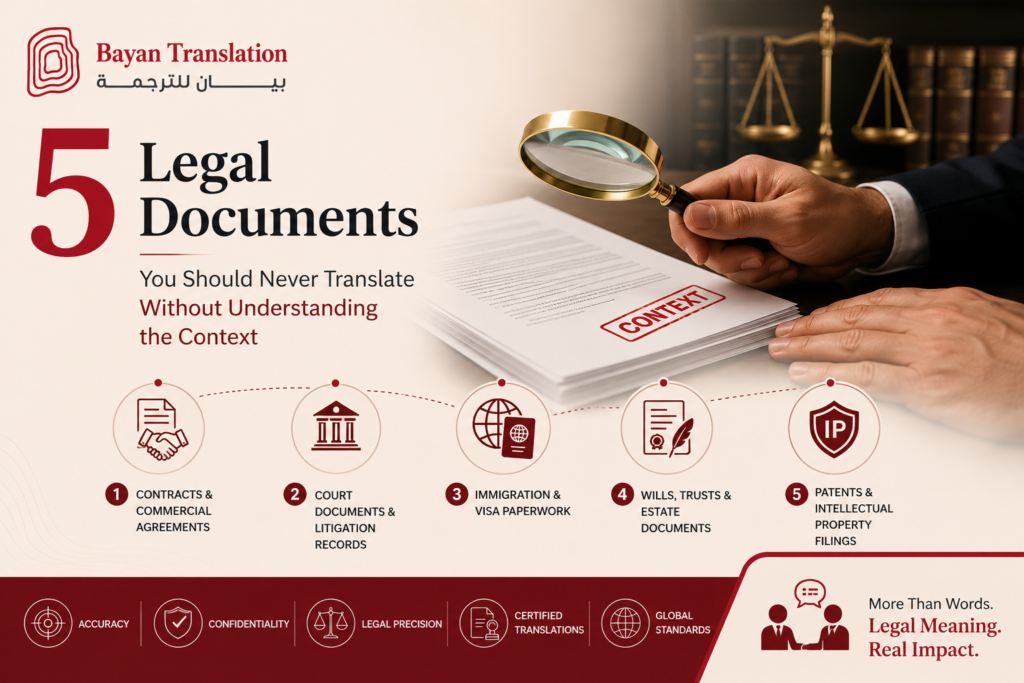
In this guide, we’ll look at five types of legal documents where translating the words without understanding the context can create serious problems — and what to look for in a professional legal translation.
Table of Contents
- Why Legal Translation Isn’t Just About Language
- Contracts and Commercial Agreements
- Court Documents and Litigation Records
- Immigration and Visa Paperwork
- Wills, Trusts, and Estate Documents
- Patents and Intellectual Property Filings
- How to Choose the Right Legal Translation Partner
- FAQs
- Conclusion
Why Legal Translation Isn’t Just About Language
Every legal system has its own logic, and that logic gets baked into its vocabulary. “Common law” doesn’t exist in civil law countries. “Trust” and “escrow” often have no direct equivalent outside English-speaking jurisdictions. Even a word as simple as “domicile” can mean something legally different from “residence,” depending on where it’s used.
A translator working purely on language will reach for the closest-sounding word. A translator working with legal context asks a different question first: what is this word doing in this document, and what happens legally if it’s replaced with something slightly off?
That’s the real difference between general translation and legal translation services — and it’s why the same sentence can be translated correctly by one provider and incorrectly by another, even though both versions “read fine.”
1. Contracts and Commercial Agreements
Contracts are built on precise obligations. Terms like “indemnify,” “force majeure,” or “joint and several liability” carry specific legal meaning that shifts depending on jurisdiction.
Why This Is High Risk
A poorly translated contract can:
- Create ambiguity around payment terms or deadlines
- Misstate which country’s laws govern a dispute
- Accidentally waive rights that were never meant to be waived
Real-World Example
Imagine a licensing agreement where “best efforts” is translated into a phrase that legally implies “reasonable efforts” in the target country. That subtle shift changes the entire obligation of one party — and could become the center of a lawsuit.
2. Court Documents and Litigation Records
Court filings, pleadings, depositions, and judgments are among the most sensitive documents to translate. They often need to be submitted to a foreign court, which means accuracy isn’t just important — it’s legally required.
This is where court translation services come in, since many jurisdictions require certified or sworn translators for anything submitted as evidence.
Common Court Documents Requiring Careful Translation
- Witness statements and depositions
- Judgments and rulings
- Subpoenas and summonses
- Evidence exhibits
What Can Go Wrong
Courts may reject documents that aren’t certified correctly, or worse, a mistranslation could distort testimony in a way that affects the outcome of a case. Judges and opposing counsel will scrutinize translated evidence closely, so there’s little room for error.
3. Immigration and Visa Paperwork
Immigration documents — birth certificates, marriage certificates, police clearance letters, and academic transcripts — must align exactly with how immigration authorities expect information to be formatted.
Why Context Matters Here
- Names, dates, and official titles must match government records exactly
- Some countries require specific certification stamps or translator credentials
- Formatting differences (like date order) can trigger unnecessary delays
A missing apostille, an incorrectly translated academic degree title, or a mismatched name spelling can delay a visa application by months.
4. Wills, Trusts, and Estate Documents
Estate planning documents are deeply tied to the legal traditions of the country where they were created. Concepts like “executor,” “beneficiary,” or “power of attorney” don’t always translate cleanly across legal systems.
Key Risks
- Misinterpreted inheritance rights
- Confusion between civil law “forced heirship” rules and common law “freedom of testation”
- Errors that could be challenged in probate court
Why Professional Translation Is Non-Negotiable
Family members can end up in court disputes over an estate simply because a translated will used the wrong legal term for who inherits what. Getting this right the first time avoids years of legal conflict.
5. Patents and Intellectual Property Filings
Patents combine legal precision with highly technical language, making them one of the hardest document types to translate accurately.
Why This Is Especially Tricky
- Patent claims must match technical specifications exactly
- A single mistranslated word can narrow or broaden a patent’s legal protection
- International filings often require translation into multiple languages, each with its own patent office standards
The Business Impact
If a patent claim is translated too broadly or too narrowly, competitors may exploit the gap — either by copying the technology or challenging the patent’s validity.
How to Choose the Right Legal Translation Partner
Not all translation providers are equipped to handle legal work. Here’s what to look for:
- Subject-matter expertise — translators with legal backgrounds or specialized legal training
- Certification options — especially important for court, immigration, or notarized documents
- Confidentiality protocols — legal documents often contain sensitive personal or business information
- Quality assurance process — a second legal reviewer should check translated documents
- Experience with your specific document type — contracts, patents, and court filings each require different expertise
Choosing experienced legal document translation services isn’t just about language fluency — it’s about legal accuracy, cultural context, and procedural compliance.
FAQs
1. What’s the difference between certified and standard translation for legal documents? Certified translation includes a signed statement confirming accuracy, often required for court, immigration, or government submissions. Standard translation doesn’t carry that formal certification.
2. Do I need a sworn translator for court documents? In many countries, yes. Sworn or certified translators are authorized to produce translations that courts will accept as legally valid.
3. Can I use machine translation for legal documents? Machine translation can help with a quick understanding of content, but it shouldn’t be relied on for anything submitted officially. Legal nuance and context are easy for automated tools to miss.
4. How long does legal document translation typically take? Turnaround depends on document length and complexity, but straightforward documents like certificates often take a few business days, while lengthy contracts or patents can take longer.
5. What happens if a legal translation contains an error? Errors can lead to document rejection, legal disputes, delayed proceedings, or unenforceable contract terms, depending on the severity of the mistake.
6. Are legal translators different from regular translators? Yes. Legal translators typically have specialized training in legal terminology and an understanding of how legal systems differ between countries.
7. Which documents most commonly require legal translation? Contracts, court filings, immigration paperwork, wills, and patents are among the most frequently translated legal document types.
Conclusion
Legal documents don’t leave much room for interpretation — literally. Translating them without understanding the legal, cultural, and procedural context behind the words can lead to costly delays, disputes, or outright document rejection.
Whether it’s a contract, a court filing, an immigration form, a will, or a patent, the safest approach is working with experienced legal document translation services that understand both the language and the law behind it.
Don’t leave your legal documents open to misinterpretation. Work with Bayan Translation for a solution you can rely on — because when it comes to legal paperwork, accuracy isn’t optional. Reach out today to get your documents translated correctly the first time.