
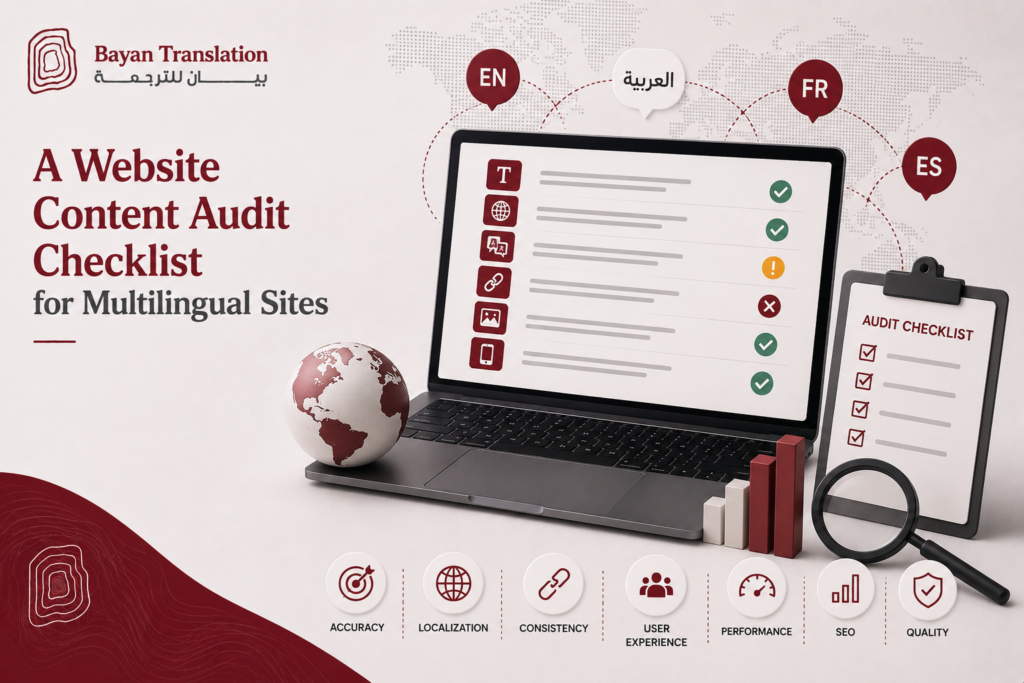
Most multilingual websites are quietly losing customers to problems their owners cannot see — because the issues live in languages the team does not read. A website content audit is a systematic review of your site’s content across every language to find gaps, errors, inconsistencies, and missed opportunities. For businesses operating in Arabic and English across Egypt, Oman, and the Gulf, a regular audit is how you make sure every version of your site works as hard as the original.
Why multilingual sites need auditing
When content is translated and localised over time, by different people and tools, drift is inevitable: some pages get updated in English but not Arabic, terminology varies from page to page, translated text overflows layouts, and calls to action lose their punch in the second language. Because teams rarely read all their own languages fluently, these problems go unnoticed while steadily eroding trust and conversion. An audit surfaces them so they can be fixed deliberately rather than discovered by frustrated customers.
1. Content completeness and parity
Start by checking that every page, section, and element exists in every language. Common gaps include untranslated pages, English text left inside Arabic pages, missing meta descriptions, and forms or error messages that were never localised. The goal is parity: an Arabic visitor should have the same complete experience as an English one, with nothing left in the wrong language.
2. Linguistic accuracy and quality
Review translations for accuracy, grammar, and natural phrasing. Look for literal or machine-translated passages that read awkwardly, mistranslations that change meaning, and tone that does not match the brand. For Arabic, confirm the right variety (MSA or dialect) is used for each content type and that the register suits the audience.
3. Terminology consistency
Check that key terms — product names, features, industry vocabulary — are translated the same way everywhere. Inconsistent terminology confuses readers and weakens SEO. A glossary and translation memory prevent this going forward, and the audit is the moment to build or update them.
4. Right-to-left and formatting integrity
For Arabic pages, verify RTL layout is correct: mirrored interface, proper text direction, clean rendering of mixed Arabic-Latin content (brand names, numbers, URLs), and no overflowing or truncated text. Check fonts render Arabic shaping correctly and that dates, numbers, and currency follow local conventions.
5. Multilingual SEO signals
Audit the technical SEO that makes localised content findable: correct hreflang tags, self-referencing canonicals that agree with hreflang, localised meta titles and descriptions, translated URLs where appropriate, and Arabic keyword optimisation rather than literal keyword translation. Missing or broken hreflang is one of the most common — and most costly — findings.
6. Cultural fit and localisation depth
Go beyond words to assess whether imagery, examples, currencies, contact details, and references are localised for each market. Content that is translated but not localised — showing the wrong currency, foreign examples, or culturally mismatched visuals — signals that the market is an afterthought.
7. Calls to action and conversion elements
Check that CTAs, buttons, forms, and conversion copy are not just translated but persuasive in each language. Marketing-critical elements often need transcreation, not literal translation, to drive the same action. Weak or literal CTAs are a frequent cause of lower conversion on localised pages.
8. Prioritised remediation plan
An audit is only valuable if it leads to action. Compile findings into a prioritised list — ranking issues by impact and effort — so the team can fix high-impact problems (broken hreflang, missing pages, mistranslations on key pages) first, then work through the rest. This turns a long list of issues into a clear, actionable roadmap.
How Bayan Translation runs content audits
Bayan Translation’s Website Content Auditing service reviews your multilingual site end to end — completeness, linguistic quality, terminology, RTL integrity, multilingual SEO, cultural fit, and conversion — and delivers a prioritised remediation report, then fixes what we find. Ideal for Arabic-English sites across Egypt, Oman, and the Gulf, under ISO 17100 & ISO 9001 quality.
Turning audit findings into lasting systems
The most valuable outcome of an audit is not the one-time fix but the systems that stop problems recurring. Establish a translation memory and glossary so terminology stays consistent, define a workflow that updates every language whenever the source changes, and assign clear ownership for multilingual content. With these foundations, your site stays in parity by design rather than drifting until the next audit — protecting the investment you have made in reaching Arabic-speaking audiences.
Who should run your audit
An effective multilingual audit needs people who can actually read and evaluate every language on your site, combined with technical SEO and localisation expertise. Relying on team members who do not read Arabic fluently — or on automated tools alone — misses exactly the linguistic and cultural issues that matter most. A specialist partner brings native linguists, SEO knowledge, and RTL expertise together, so the audit catches problems that would otherwise stay invisible until they cost you customers.
How often and when to audit
Beyond an annual review, certain moments call for an immediate audit: after a website redesign or replatform, before entering a new market, following a major content or product launch, or when analytics show localised pages underperforming their English equivalents. Auditing at these inflection points catches issues while they are cheap to fix and ensures every new expansion starts from a clean, consistent multilingual foundation.
The bottom line
A multilingual website is only as strong as its weakest language, and the problems are usually invisible to the team that owns the site. A structured content audit — covering completeness, quality, terminology, RTL, SEO, cultural fit, and conversion — turns those hidden issues into a clear, prioritised plan. For Arabic-English businesses across Egypt, Oman, and the Gulf, it is one of the highest-return investments you can make in your existing site, unlocking value from content you have already paid to create.
FAQ
How often should I audit my multilingual site? At least annually, and after any major redesign or content push.
Can you fix the issues, not just report them? Yes — we deliver the audit and then remediate translation, terminology, RTL, and SEO issues.
What is the most common problem you find? Broken or missing hreflang and pages updated in one language but not the other.
Want to know what your Arabic site is missing? Request a free quote.