
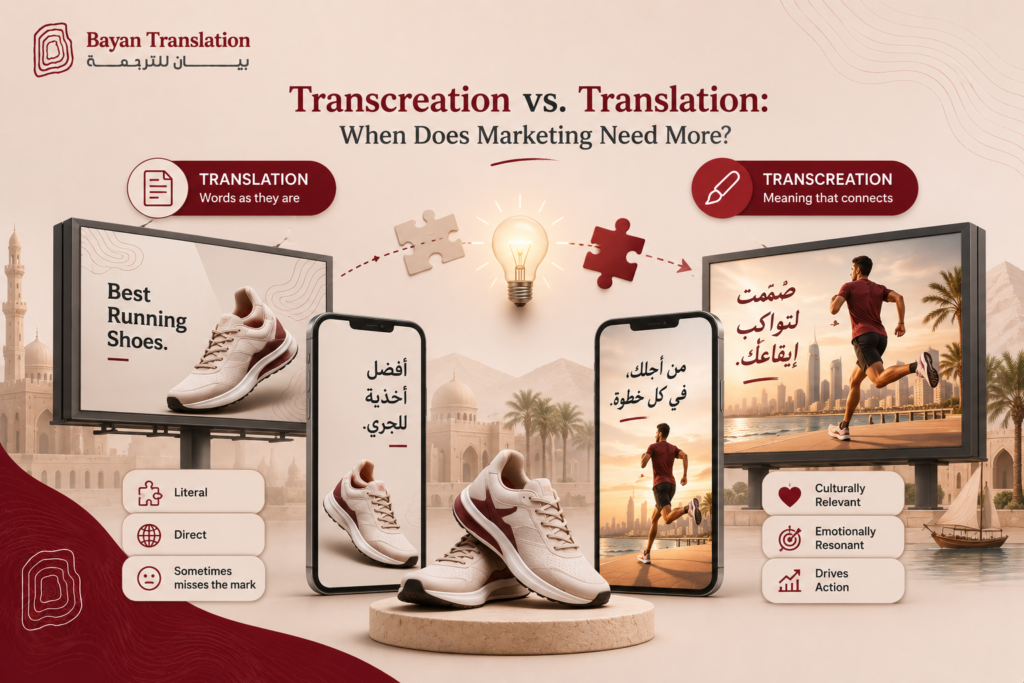
Translation makes your words understandable; transcreation makes them persuasive. For marketing, slogans, campaigns, and brand messaging entering Arabic-speaking markets like Egypt, Oman, and the Gulf, a literal translation is often worse than no translation at all — because the words may be accurate while the meaning, emotion, and cultural fit are completely lost. Knowing when you need transcreation instead of translation protects your brand and your budget.
What transcreation means
Transcreation — a blend of “translation” and “creation” — is the process of adapting a message from one language and culture to another so that it evokes the same emotions, carries the same intent, and drives the same action as the original, even if the actual words change substantially. Where translation stays faithful to the source text, transcreation stays faithful to the source effect. A transcreator is effectively a bilingual copywriter, working from a creative brief rather than a source sentence.
Why literal translation fails in marketing
Marketing language is dense with wordplay, idioms, humour, cultural references, and emotional triggers — exactly the elements that do not survive a word-for-word crossing. A pun that delights in English may be meaningless in Arabic; a metaphor that resonates in one culture may confuse or offend in another; a call to action that feels bold in one market may feel rude in another. History is full of global brands whose slogans, translated literally, became embarrassing or nonsensical in Arabic. Transcreation exists to prevent exactly that.
Translation vs transcreation: the practical difference
- Source material: translation works from a text; transcreation works from a creative brief describing the message, tone, and desired response.
- Fidelity: translation is faithful to words; transcreation is faithful to intent and emotion.
- Output: translation produces one broadly correct version; transcreation may produce several creative options with rationale.
- Skill set: translation needs linguistic accuracy; transcreation needs copywriting and cultural-marketing instinct.
- Pricing: translation is typically per word; transcreation is priced by effort or by hour, like creative work.
When you need transcreation
Reach for transcreation when the text is designed to persuade or move people: taglines and slogans, advertising campaigns, brand names and positioning, social-media creative, email subject lines, packaging, and hero website copy. These carry brand voice and emotional weight that must land natively. By contrast, informational and technical content — manuals, contracts, product specs, help articles — needs accurate translation, not creative reinvention. Most brands need both, applied to the right content.
Cultural adaptation is central
Transcreation for the Arab world goes beyond language into culture: imagery, colour associations, humour, religious sensitivity, gender norms, and local references all shape how a message is received. A transcreator flags when a visual or concept will not work in the region and proposes an alternative that preserves the campaign’s spirit while fitting the culture. This cultural gatekeeping is one of transcreation’s most valuable functions, protecting brands from costly missteps.
The transcreation process
A good transcreation engagement starts with a creative brief — the message, target audience, tone of voice, brand guidelines, and the response you want to provoke. The transcreator then develops adapted options, often with back-translation and a rationale explaining the choices, so stakeholders who do not read Arabic can understand and approve the creative direction with confidence. It is a collaborative, iterative process closer to working with an agency than commissioning a translation.
How Bayan Translation approaches transcreation
Bayan Translation pairs native Arabic copywriters with cultural consultants to transcreate slogans, campaigns, and brand messaging for Egypt, Oman, and the Gulf — delivering adapted options with back-translation and rationale, so your message persuades in Arabic as powerfully as it does in the original, backed by ISO 17100 & ISO 9001 quality.
Measuring transcreation’s return
Because transcreation costs more per unit than translation, it is fair to ask what it returns. The answer shows up in engagement and conversion: campaigns that feel native earn higher click-through, stronger recall, more sharing, and better conversion than literally translated equivalents that feel foreign or awkward. On brand-critical assets — the tagline a market remembers you by, the ad that defines a launch — the cost of getting it wrong dwarfs the cost of transcreation. The discipline pays for itself precisely where the stakes are highest.
Transcreation and brand consistency
A recurring worry is that adapting a message will dilute the brand. Done well, the opposite is true: transcreation preserves brand voice and intent across languages by re-expressing them natively, rather than freezing the exact words and letting the meaning drift. Working from brand guidelines and a shared glossary, transcreators keep tone, personality, and positioning consistent from market to market — so your brand feels like itself in Arabic, not like a translated stranger.
Working with a transcreation partner
The best results come from treating transcreation as a creative collaboration. Provide a clear brief, share the thinking behind the original campaign, and give feedback on the adapted options rather than expecting a single perfect answer on the first pass. Because transcreation is iterative, a short review cycle — with back-translation to keep non-Arabic stakeholders in the loop — produces messaging everyone can stand behind. Chosen well, a transcreation partner becomes an extension of your marketing team in the region.
Getting started with transcreation
If you are entering Arabic-speaking markets, begin by auditing your content and separating it into two buckets: persuasive, brand-heavy assets that need transcreation, and informational assets that need accurate translation. Prioritise transcreation for the pieces that define first impressions — your tagline, hero messaging, and flagship campaign — then expand from there. This focused approach delivers the biggest impact for your budget and builds a native-feeling brand presence across Egypt, Oman, and the Gulf.
FAQ
Is transcreation more expensive than translation? Per unit yes, because it is creative work — but on marketing content it delivers far better results and protects the brand.
Do I need transcreation for my whole website? Usually no — transcreate the persuasive, brand-heavy pages and translate the informational ones.
Will I be able to review the Arabic if I don’t read it? Yes — we provide back-translation and rationale so you can approve confidently.
Launching a campaign in Arabic? Request a free quote.