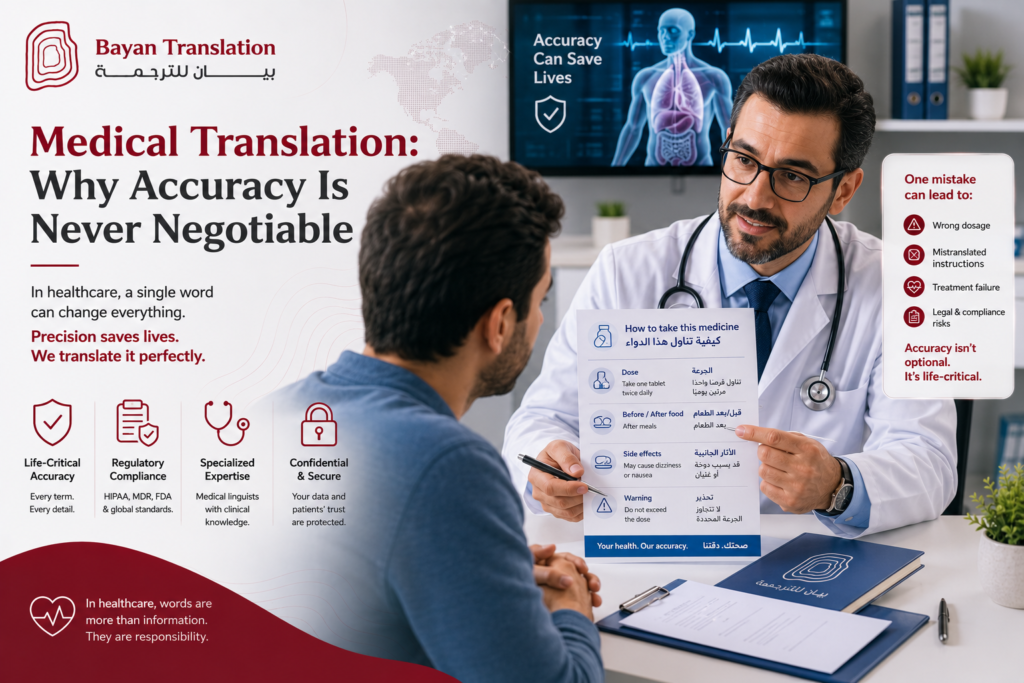
In medical translation, there is no such thing as a small error — a single mistranslated dosage, diagnosis, or instruction can cost a life. That is why accuracy in medical and healthcare translation is never negotiable. For hospitals, pharmaceutical companies, research organisations, and medical-device makers operating across Egypt, Oman, and the Gulf, medical translation is not a commodity service but a patient-safety and regulatory-compliance function that demands the highest possible standards.
Why medical translation is uniquely high-stakes
Most translation errors cause confusion or embarrassment; medical translation errors can cause harm. A misread dosage instruction, an inverted contraindication, an ambiguous diagnosis, or a mistranslated consent form can lead to incorrect treatment, adverse events, legal liability, and regulatory rejection. The consequences fall on real patients and on the organisations responsible for their care. This is why medical translation sits in a category of its own, governed by rigorous processes and entrusted only to specialists with proven competence.
The specialised knowledge it demands
Medical translation requires far more than bilingual fluency. Translators must understand medical terminology, anatomy, pharmacology, disease processes, and the conventions of clinical writing in both languages. They must know that a term has a precise clinical meaning distinct from its everyday sense, recognise abbreviations and units, and render them without ambiguity. Many professional medical translators have healthcare or life-sciences backgrounds precisely because the subject knowledge is inseparable from the language skill. A general translator, however capable, is not equipped for this work.
The range of medical documents
Healthcare translation spans a wide and varied set of documents, each with its own demands: clinical trial protocols and case report forms, patient information leaflets and informed-consent forms, regulatory submissions and dossiers, drug labels and packaging, instructions for use for medical devices, hospital records and discharge summaries, scientific and pharmaceutical research, and marketing materials for healthcare products. Each type carries its own terminology, regulatory context, and risk profile, and each must be translated with complete accuracy and appropriate register for its audience — whether that audience is a regulator, a clinician, or a patient.
Regulatory compliance and market access
Medical translation is tightly bound to regulation. Health authorities require accurate translations of drug and device documentation as a condition of market approval, and errors or inconsistencies can delay or derail a submission. Patient-facing materials often must meet readability and language requirements. For companies bringing pharmaceuticals or devices into Egypt, Oman, and the Gulf, compliant Arabic translation is not optional — it is a gateway to the market, and getting it wrong is expensive in both time and money.
The role of back-translation and QA
Because the stakes are so high, medical translation uses rigorous quality processes that go beyond standard translation. Back-translation — where an independent linguist translates the target text back into the source language to verify meaning has been preserved — is common for critical documents like consent forms and trial materials. Multiple rounds of review, terminology verification against approved glossaries, and reconciliation of discrepancies are standard. These safeguards exist specifically to catch the subtle errors that could otherwise reach a patient.
Terminology consistency across a programme
Pharmaceutical and clinical programmes generate large volumes of related documents over years, and terminology must stay perfectly consistent across all of them. Approved glossaries and translation memories ensure that a drug name, a condition, or a procedure is always rendered identically, across every document and every update. Inconsistency in medical terminology is not just untidy — it can create genuine clinical ambiguity, so terminology management is a core part of professional medical translation rather than an optional extra.
Confidentiality and data protection
Medical documents contain some of the most sensitive information that exists — patient data, unpublished research, proprietary formulations. Professional medical translation is conducted under strict confidentiality and data-protection safeguards, with secure handling, non-disclosure agreements, and controlled access. Organisations must ensure their translation partner treats this information with the same care they are obliged to, particularly given the legal and ethical duties surrounding health data.
The Arabic medical translation challenge
Translating medical content into Arabic adds specific complexity: developing accurate Arabic terminology for concepts and drugs, handling the right register for patient versus professional audiences, managing right-to-left formatting alongside Latin-script drug names and measurements, and meeting regional regulatory expectations. This requires linguists experienced specifically in Arabic medical translation, working within a rigorous quality framework — not generalists and certainly not unverified machine translation.
How Bayan Translation delivers medical translation
Bayan Translation provides specialised medical and healthcare translation — clinical trials, regulatory dossiers, patient materials, device documentation, and pharmaceutical content — with subject-expert linguists, back-translation and multi-stage QA, terminology management, and strict confidentiality, serving healthcare and life-sciences clients across Egypt, Oman, and the Gulf under ISO 17100 & ISO 9001 quality.
The cost of getting it wrong versus getting it right
It can be tempting to economise on translation, but medical content is precisely where economising is most dangerous. A rejected regulatory submission delays market entry and burns budget; an adverse event traced to a mistranslated instruction can bring legal and reputational consequences far exceeding any saving. Professional medical translation, by contrast, protects patients, smooths regulatory approval, and safeguards the organisation. Viewed properly, rigorous medical translation is not a cost to minimise but a risk-management investment that pays for itself many times over.
Choosing a medical translation partner
When selecting a partner for healthcare content, look for demonstrable subject expertise, relevant certifications, robust quality processes including revision and back-translation, terminology management, secure and confidential handling, and experience with the specific document types and regulatory context you need. Ask how linguists are qualified and how errors are caught before delivery. A serious medical translation provider will have clear answers — because in this field, process and expertise are exactly what stand between a document and a patient’s safety.
FAQ
Why can’t I use general translators for medical documents? Medical translation requires subject expertise; errors risk patient safety, legal liability, and regulatory rejection.
What is back-translation? An independent translation of the target text back to the source to verify meaning was preserved — standard for critical medical documents.
Is my medical data kept confidential? Yes — all work is handled under strict confidentiality and data-protection safeguards.
Need accurate, compliant medical translation? Request a free quote.