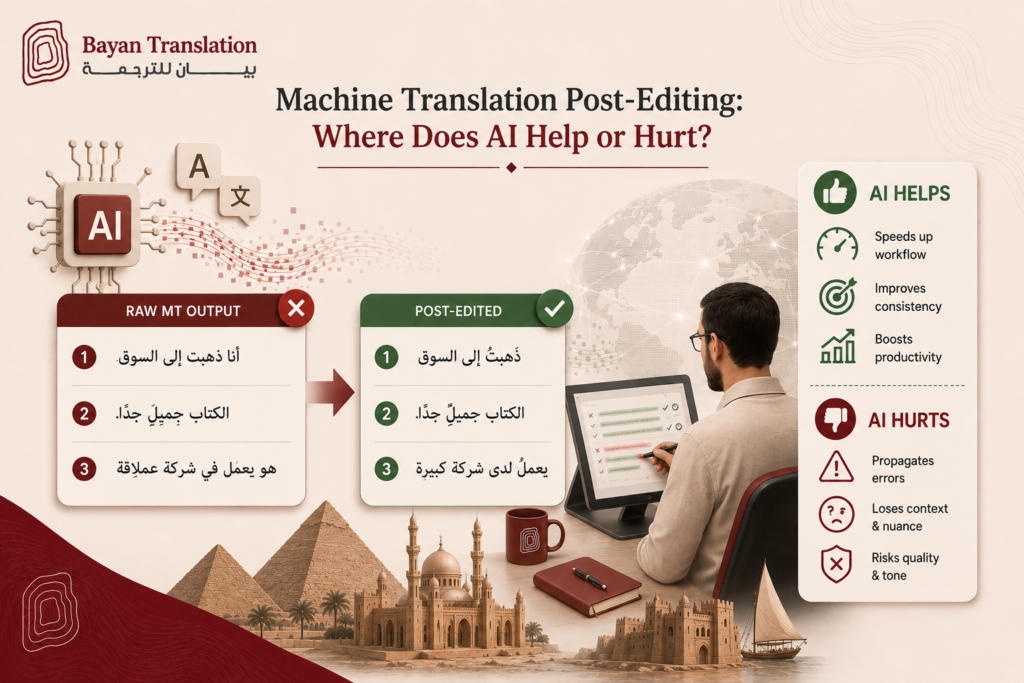
Machine translation has become genuinely useful — but only when a skilled human decides where to trust it and where to override it. Machine translation post-editing (MTPE) is the discipline of using AI to produce a first draft and then having a professional linguist refine it to publishable quality. Used well, it cuts cost and turnaround on the right content. Used blindly, it ships errors that damage your brand, your compliance, and your credibility across Egypt, Oman, and the wider Arabic market.
What post-editing actually is
MTPE is not “proofreading a computer’s output” in a casual sense. It is a defined workflow: a trained machine-translation engine generates a raw translation, and a qualified human editor then corrects meaning, terminology, grammar, tone, and cultural fit to the required standard. It sits between two extremes — fully automated translation (fast, cheap, risky) and full human translation from scratch (highest quality, higher cost) — and when applied to suitable content it captures much of the speed benefit without the raw-MT risk.
Light vs full post-editing
Not all post-editing aims for the same finish. Light post-editing makes the text accurate and understandable, accepting that it may not read as elegantly as human-written prose — appropriate for internal documents, low-visibility content, or high-volume material where comprehension is the goal. Full post-editing brings the text to a quality indistinguishable from human translation, with correct terminology, natural style, and brand voice — required for anything customer-facing or published. Agreeing the level up front sets expectations, price, and turnaround correctly.
Where machine translation helps
MT with post-editing shines on large volumes of repetitive, structured, or lower-risk content: product catalogues, user-generated reviews, internal knowledge bases, support articles, and technical documentation with consistent terminology. In these domains, modern neural and AI engines — especially when trained on your data and paired with a translation memory and glossary — produce strong first drafts that a human can finish quickly. The result is faster time-to-market and lower cost on content that would be uneconomic to translate entirely by hand.
Where machine translation hurts
MT is dangerous on content where nuance, creativity, or accuracy carry real consequences. Marketing and brand messaging need transcreation, not literal MT. Legal contracts, medical documents, financial disclosures, and safety-critical instructions demand certified human accuracy, because a single mistranslation can cause legal liability or physical harm. And Arabic poses specific challenges: rich morphology, heavy context-dependence, dialect variation, and right-to-left formatting all trip up engines in ways that require experienced human correction. On this content, “post-editing” often means near-total rewriting — so full human translation is usually safer and no more expensive.
The Arabic-specific challenge
Arabic is one of the harder languages for machine translation. Words carry meaning through root patterns and inflection; short vowels are often unwritten, creating ambiguity; the same term shifts meaning by domain; and Modern Standard Arabic differs sharply from the dialects people actually speak. Engines frequently choose the wrong sense, mangle agreement, or produce stilted output that a native reader spots instantly. This is why Arabic MTPE requires editors who are native speakers and subject-matter aware — not just bilingual reviewers skimming for typos.
Quality, security, and the hidden risks
Two risks are easy to overlook. First, quality drift: raw MT can be fluent yet wrong — confidently producing a grammatical sentence that means the opposite of the source. Only a careful human catches these “fluent errors”. Second, confidentiality: pasting sensitive documents into public, free MT tools can expose private data, because some services retain and reuse inputs. Professional MTPE uses secure, enterprise-grade engines under proper data agreements, protecting your confidential and regulated content.
Building an effective MTPE workflow
A mature MTPE process combines the right engine (ideally trained on your content), a maintained translation memory and glossary for consistency, clear post-editing guidelines, qualified human editors, and a QA step. It also includes triage: deciding, content type by content type, whether to use light MTPE, full MTPE, or full human translation. That routing decision — made by people who understand both the technology and the risk — is what separates cost-saving from corner-cutting.
How Bayan Translation combines AI and human expertise
Bayan Translation offers AI Language Solutions with professional post-editing: secure, trained engines for suitable high-volume content, finished by native Arabic linguists, alongside full human and certified translation for legal, medical, and brand-critical material. We help you route each content type to the right approach across Egypt, Oman, and the Gulf, under ISO 17100 & ISO 9001 quality and strict confidentiality.
Pricing and turnaround: what to expect
MTPE is usually priced below full human translation but above raw machine output, reflecting the human effort involved. The savings depend heavily on how good the raw output is: clean, structured source text in a well-trained engine needs light editing and delivers real savings, while messy or nuanced content may need so much correction that human translation would have been faster and cheaper. A reputable provider evaluates a sample before quoting, so you pay for the approach that genuinely fits your content rather than a blanket per-word rate.
Common misconceptions about MTPE
Two myths cause trouble. The first is that MTPE is “free translation with a quick check” — in reality, quality post-editing is skilled work, and cutting it produces fluent-sounding errors that slip through. The second is that if the machine output looks fluent, it must be correct; Arabic in particular can read smoothly while conveying the wrong meaning. Understanding that fluency and accuracy are different things is the key to using AI translation responsibly rather than dangerously.
A practical decision guide
Ask three questions of any content: How visible is it? How much would an error cost? How creative or nuanced is it? High-visibility, high-risk, or creative content — marketing, legal, medical — belongs with human experts. Low-visibility, low-risk, repetitive content is a strong candidate for MTPE. Answering these honestly, content type by content type, lets you capture AI’s speed where it is safe and protect quality where it matters.
FAQ
Is post-edited machine translation as good as human translation? With full post-editing on suitable content, yes — but brand, legal, and medical material is best done by humans from the start.
Is it safe to use free online translators for company documents? No — free tools may retain your data; use secure, enterprise engines under a data agreement.
Does MTPE work well for Arabic? For structured, repetitive content yes; for nuanced or creative Arabic, human translation is usually safer.
Want the right mix of AI speed and human quality? Request a free quote.