
When buyers compare translation providers, two standards keep appearing — ISO 17100 and ISO 9001 — and understanding the difference tells you a great deal about the quality you are actually buying. They are not interchangeable, and they are strongest together. For organisations procuring translation across Egypt, Oman, and the Gulf, knowing what each certification proves helps you choose a partner whose quality is verified, not merely claimed.
What ISO 9001 is
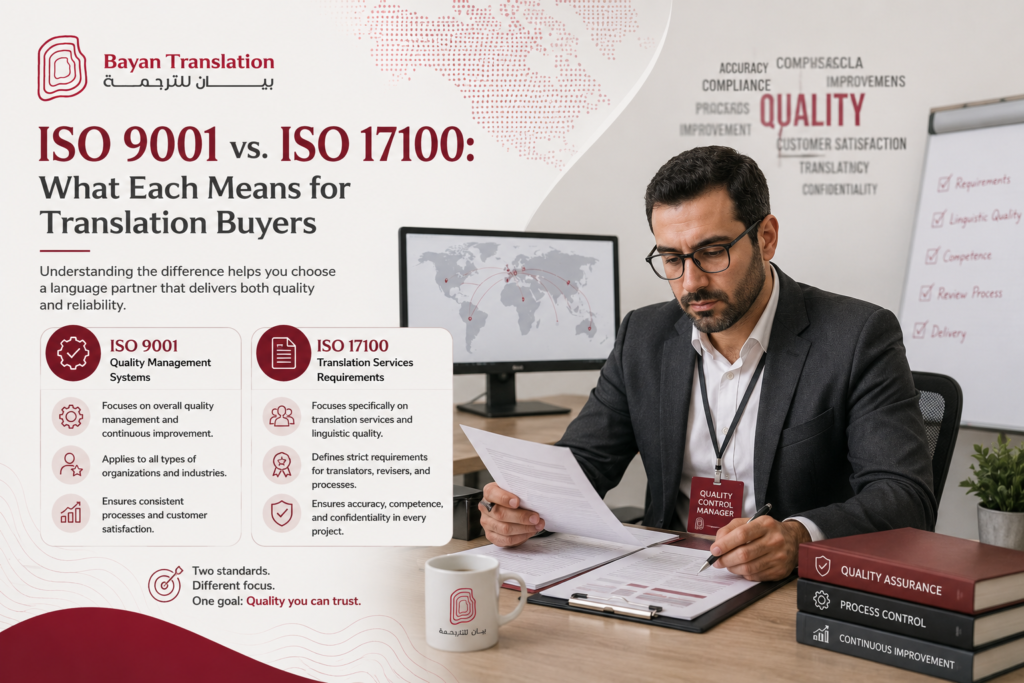
ISO 9001 is the world’s most widely recognised standard for quality management systems, applicable to organisations in any industry. It certifies that a company has structured, documented processes for managing quality — clear responsibilities, consistent procedures, customer-focus, risk management, and a commitment to continual improvement. An ISO 9001-certified organisation has demonstrated, through independent audit, that it runs disciplined, repeatable processes rather than relying on ad-hoc effort. It speaks to how the business as a whole is managed.
What ISO 17100 is
ISO 17100 is the international standard specifically for translation services. It goes deeper than general quality management into the requirements of professional translation: the qualifications and competence of translators and revisers, the mandatory revision of translations by a second qualified linguist, the management of projects and resources, and the handling of client requirements and terminology. Crucially, ISO 17100 requires that every translation be revised by a second professional — a “four-eyes” principle that directly protects quality. It speaks to how translation specifically is produced.
The key difference
The simplest way to understand the distinction: ISO 9001 certifies that the organisation manages quality well in general, while ISO 17100 certifies that the translation process specifically meets professional standards, including translator competence and independent revision. ISO 9001 is broad and applies to any business; ISO 17100 is narrow, deep, and specific to translation. One tells you the company is well-run; the other tells you the translation itself is produced to a professional, verifiable standard.
Why both matter together
The two standards are complementary, not competing. A provider holding both demonstrates that its overall business is managed to a recognised quality standard and that its core translation work meets the specific professional requirements of the language industry. This combination gives buyers strong assurance across both dimensions — organisational reliability and linguistic quality. It is why serious translation buyers, particularly in government, legal, medical, and corporate procurement, increasingly look for both certifications rather than either alone.
What these certifications mean for buyers
For a translation buyer, certification reduces risk. It provides independent, audited evidence — not just marketing claims — that the provider has qualified linguists, revision processes, quality controls, and proper project management. In regulated or high-stakes work, this assurance is often a procurement requirement. Even where it is not mandatory, certification is a strong signal that separates professional providers from unverified operators competing on price alone. It is a shortcut to trust when you cannot audit a provider yourself.
What certification does not guarantee
Certification is powerful but not a complete guarantee of every outcome. It proves that processes and competences meet defined standards; it does not, by itself, guarantee that a specific translator is a subject-matter expert in your niche, or that the provider has experience in your exact field. Buyers should treat certification as a strong baseline and then verify domain expertise, relevant experience, confidentiality practices, and references for their particular needs. Certification and specialisation together are what deliver consistently excellent results.
How to verify a provider’s certifications
Because certification carries weight, it is worth confirming. Reputable providers will readily share their certificates and the scope they cover, and certifications can often be verified through the issuing certification body. Check that the certification is current and that its scope actually covers translation services. A provider confident in its quality will welcome the question — reluctance to substantiate a claimed certification is itself a useful signal.
Bayan Translation’s certifications
Bayan Translation holds both ISO 17100 and ISO 9001, reflecting a commitment to professional translation quality and disciplined organisational management alike. Combined with over two decades of experience, subject-matter expertise, and strict confidentiality, this gives clients across Egypt, Oman, and the Gulf verified assurance that their work is produced to internationally recognised standards.
Making the right procurement decision
When you put translation work out to tender, treat certifications as a filter and specialisation as the deciding factor. Require evidence of ISO 17100 and ISO 9001 to ensure a professional baseline, then probe for genuine experience in your field — legal, medical, technical, or marketing — along with confidentiality practices and references. This two-step approach protects you from both unverified operators and well-certified generalists who lack domain depth, giving you a partner whose quality is both proven and relevant to your specific needs.
Certification as part of a bigger quality picture
Finally, remember that certifications describe the framework within which quality is produced, not the whole of quality itself. The best providers pair ISO 17100 and ISO 9001 with expert linguists, mature terminology management, secure processes, and a genuine commitment to understanding each client’s context. It is that combination — verified standards plus real expertise and care — that consistently delivers translation you can rely on for your most important work across Egypt, Oman, and the Gulf.
The bottom line
ISO 17100 and ISO 9001 answer two different questions — is the translation produced to a professional standard, and is the organisation managed to a recognised quality standard — and the strongest providers can answer yes to both. For buyers, insisting on both certifications, then verifying domain expertise on top, is the surest route to translation you can trust for high-stakes, regulated, or reputation-critical work across Egypt, Oman, and the Gulf.
FAQ
Is ISO 17100 better than ISO 9001? They are different — ISO 17100 is specific to translation quality; ISO 9001 covers general quality management. Both together is ideal.
Does ISO 17100 require a second linguist to check translations? Yes — independent revision by a second qualified professional is a core requirement.
Should I insist on certification? For important or regulated work, yes — it provides audited assurance beyond marketing claims.
Want translation backed by verified standards? Request a free quote.