
Inconsistent terminology is the silent tax on every multilingual operation — and a glossary is the single cheapest fix for it. When the same product, feature, or concept is translated three different ways across your website, contracts, and support articles, readers get confused, your brand looks careless, and your SEO fragments. Building a terminology glossary is the foundational first step toward consistency, and for organisations working across Arabic and English in Egypt, Oman, and the Gulf, it pays for itself many times over.
What a terminology glossary is
A terminology glossary — sometimes called a termbase — is a structured, approved list of key terms and their agreed translations, along with definitions, context, part of speech, and usage notes. It is the authoritative reference that every translator, editor, and content creator uses to ensure a given term is always rendered the same way. Far from being a simple word list, a well-built glossary captures the reasoning behind each choice, so consistency survives even as different people and vendors work on your content over the years.
Why consistency matters more than you think
Terminology inconsistency does quiet, cumulative damage. A customer who sees a feature called one thing on your website and another in the app wonders whether they are the same feature. Inconsistent legal or technical terms can create genuine ambiguity with real consequences. Search engines struggle to associate your content with a keyword when you use several variants of it. And every new translator, lacking guidance, invents their own version, compounding the drift. A glossary stops all of this at the source by making the correct term unambiguous.
Which terms belong in a glossary
A glossary should capture the terms where consistency matters most: product and feature names, brand and marketing vocabulary, industry and technical terminology, recurring UI labels, legally significant phrases, and any term that has caused confusion before. It should also record terms that must never be translated — brand names, trademarks, certain product names — so they are left intact rather than localised by a well-meaning translator. The aim is not to catalogue every word but to govern the ones that carry weight.
Building the glossary: a practical process
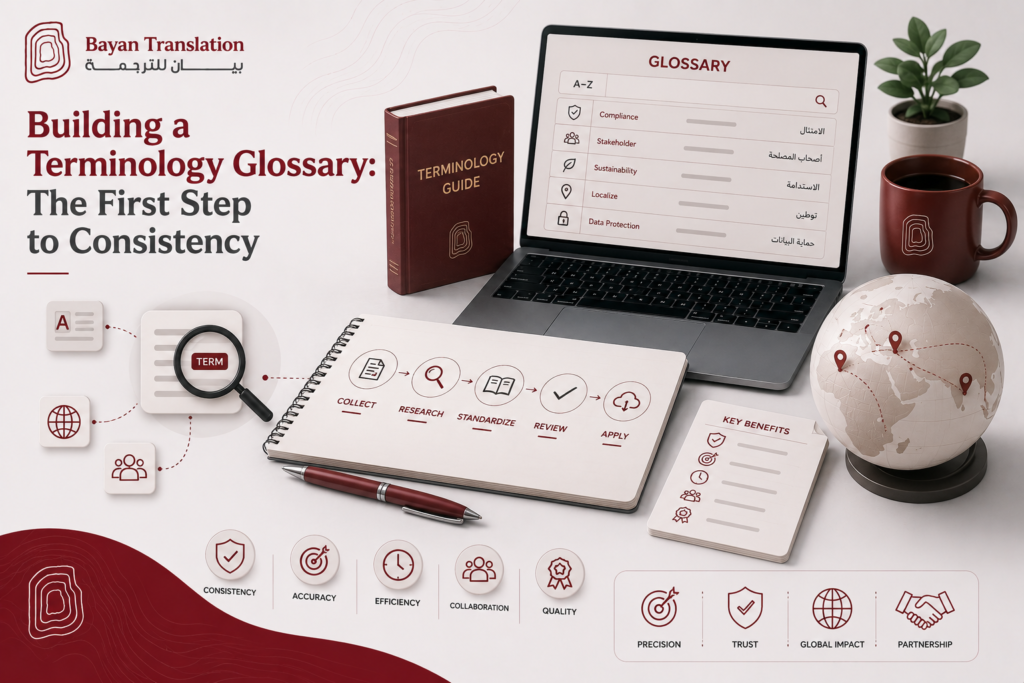
Effective glossary building starts by extracting candidate terms from your existing content — websites, manuals, contracts, marketing — either manually or with terminology-extraction tools. Subject-matter experts and linguists then agree the correct translation for each, guided by industry standards and your brand voice, and record a definition and usage note. For Arabic specifically, this stage resolves the hard questions: which established equivalent to use, how to handle concepts with no direct Arabic term, and which variety and register apply. The result is reviewed, approved, and published to everyone who touches your content.
The Arabic dimension
Arabic makes a glossary especially valuable. Many technical and modern concepts have several competing Arabic renderings, or none yet established, so leaving the choice to individual translators guarantees inconsistency. A glossary fixes the approved Arabic term for each concept, specifies whether to transliterate or translate foreign terms, and records the correct handling of gender, plural, and register. This is the difference between Arabic content that reads as a coherent, professional whole and content that feels stitched together from different sources.
Glossaries and translation memory work together
A glossary is most powerful alongside a translation memory (TM), which stores previously translated sentences for reuse. The TM ensures whole segments are translated consistently and efficiently; the glossary ensures individual key terms are always correct, even in new sentences. Together they form the backbone of a professional localisation programme, cutting cost, speeding turnaround, and steadily raising quality as they grow. Building the glossary first gives the TM a reliable terminological foundation.
Maintaining the glossary over time
A glossary is a living asset, not a one-time deliverable. As you launch products, enter markets, and evolve your brand, new terms arise and old ones change, so the glossary needs an owner and a simple process for proposing, approving, and distributing updates. Neglected glossaries drift out of date and lose the team’s trust; maintained ones become more valuable every year as they accumulate hard-won terminological decisions that would otherwise be re-litigated on every project.
The payoff
Organisations that invest in terminology management get more consistent content, faster translation turnaround, lower cost through reuse, stronger multilingual SEO, and a more professional brand across every language. The upfront effort of building a glossary is modest compared with the compounding cost of inconsistency — which is precisely why terminology management is regarded as the first, foundational step in any serious localisation strategy.
How Bayan Translation builds terminology for clients
Bayan Translation builds and maintains bilingual and multilingual glossaries and translation memories as part of our localisation and language-consulting services — extracting terms, agreeing approved Arabic and English renderings with subject-matter experts, and keeping them current — so every project for clients in Egypt, Oman, and the Gulf stays consistent, under ISO 17100 & ISO 9001 quality.
Getting started without overcomplicating it
You do not need an elaborate system to begin. Start by listing the twenty or thirty terms that matter most to your business and that appear across many pages — your product names, core features, and industry vocabulary — and agree their approved Arabic and English forms. Even this modest glossary eliminates the most common and visible inconsistencies. From there, the list grows naturally as projects surface new terms, and what began as a simple spreadsheet becomes a genuine asset that protects the quality and coherence of everything you publish in both languages.
FAQ
Do I really need a glossary for a small site? Even small sites benefit — a short glossary of your key terms prevents the most common and visible inconsistencies.
Who decides the correct Arabic term? Subject-matter experts and native linguists, guided by industry standards and your brand voice.
Can you build a glossary from our existing content? Yes — we extract terms from your current materials and agree approved translations.
Ready to make your content consistent? Request a free quote.