
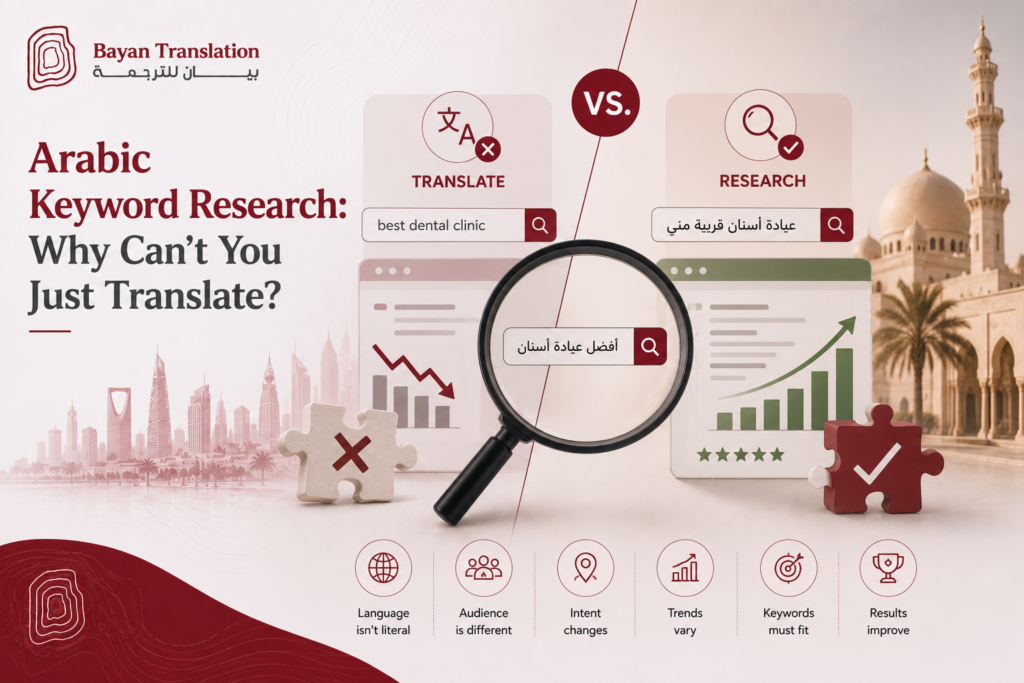
Arabic keyword research is not English keyword research translated into Arabic. The language's morphological complexity, the gulf between Modern Standard Arabic and colloquial dialects, and the transliteration problem collectively make Arabic SEO a discipline that rewards specialists and punishes shortcuts. This article explains the variables that matter and the process that works.
The MSA vs. Colloquial Split
Modern Standard Arabic (MSA / الفصحى) is the written, formal register used in news media, official communications, and formal publishing. Colloquial Arabic exists as a family of distinct dialects — Egyptian Arabic, Levantine Arabic, Gulf Arabic, Moroccan Darija — each mutually intelligible with MSA to varying degrees but often mutually unintelligible across regional boundaries.
Search behaviour in Arabic-speaking markets does not follow a single pattern. Egyptian users searching for consumer products often type in Egyptian colloquial Arabic. Business decision-makers researching B2B services may search in MSA. Users in the Gulf searching for the same category may use Gulf dialect vocabulary. There is no single Arabic keyword list that performs equally across all these contexts — the correct approach depends on your target market geography.
The Transliteration Problem
A significant portion of Arabic-speaking internet users — particularly in younger demographics — search in Arabic script transliterated into Latin characters (Arabizi). Terms like "ta3lim" for تعليم (education) or "shoghl" for شغل (work) appear frequently in informal search queries, social media, and messaging. This is not a fringe behaviour; in some categories and age groups, Arabizi queries represent a material share of total search volume.
Standard keyword research tools do not capture Arabizi queries accurately. A keyword strategy that ignores transliteration misses real search behaviour, particularly for consumer brands, entertainment, and casual information searches.
Search Intent Differences in Arabic Markets
Search intent patterns in Arabic markets often differ from equivalent intent in English-speaking markets for the same product or service category. Several factors drive this:
- Trust signals are searched explicitly. Arabic-language queries for products and services often include trust-indicator terms ("موثوق", "أصلي", "معتمد") — meaning "trusted", "genuine", "accredited" — at higher rates than equivalent English queries. This reflects different baseline trust dynamics in some markets.
- Comparison and review queries are structured differently. Arabic review queries often use different syntactic structures than their English equivalents, affecting how comparison content should be titled and structured.
- Local regulatory terms appear in commercial queries. In regulated sectors (financial services, healthcare, legal services), Arabic users frequently include regulatory or licensing terminology in commercial searches. This is keyword territory that keyword tools may underweight.
Arabic Morphology and Its Effect on Keyword Volume
Arabic is a root-based, highly inflected language. A single root produces numerous derived forms: verb conjugations, noun forms, adjective forms, plurals, dual forms, masculine/feminine variants. The word for "translation" (ترجمة) shares a root with "translator" (مترجم), "translated" (مُترجَم), and "to translate" (يترجم). Search engines index and match these forms with varying degrees of stemming — but keyword tools report volume against specific query strings.
This means that a keyword research process that captures only the nominal form of a concept misses material search volume distributed across morphological variants. Effective Arabic keyword research requires a morphologically aware approach, not a direct search-volume lookup of obvious terms.
Diacritics and Alef Variants
Arabic search queries are almost always typed without diacritics (tashkeel). A keyword strategy that relies on diacritic-marked forms risks misalignment with how users actually type. Similarly, variants of the letter Alef (أ / إ / آ / ا) are often typed inconsistently. Search engines normalise these variants to varying degrees — but keyword tool volume data may split across variants rather than aggregating them, understating true search volume.
The Correct Arabic Keyword Research Process
An effective Arabic keyword research process for content or paid search includes the following stages:
- Market-specific scope definition. Identify the primary Arabic-speaking markets you are targeting before beginning research. Egyptian Arabic, Gulf Arabic, and Levantine Arabic produce different keyword landscapes for many categories.
- Seed term development with native linguists. The seed terms that drive a keyword research process must be developed with native Arabic speakers who understand your category — not by translating an English seed list.
- Morphological expansion. For each core concept, generate the relevant morphological variants using Arabic linguistic knowledge — not just keyword tool suggestions.
- Dialect variation capture. Identify the colloquial equivalents of formal terms in your target market's primary dialect.
- Search volume validation. Validate volume estimates in keyword tools while accounting for the variant aggregation issue described above.
- Intent classification. Classify keywords by intent before any content or bid strategy decisions.
The Business Cost of Getting Arabic Keyword Research Wrong
The consequences of flawed Arabic keyword research are measurable: paid search budget directed at query strings that do not match actual user behaviour; content indexed against terms users do not search; competitor websites capturing Arabic organic traffic that should flow to your pages.
For brands entering Arabic-speaking markets or scaling existing Arabic digital presence, the keyword research phase is a decision point — not a production task that can be delegated to a non-specialist using an English-language SEO workflow.
Bayan Translation's Arabic content and SEO team works with native Arabic linguists across MSA and regional dialect variants. Our Arabic keyword research processes incorporate morphological analysis, dialect mapping, and intent classification appropriate to your specific market targets.


- Search intent shifts by dialect — an Egyptian user and a Gulf user rarely type the same term for the same product.
- Search volume and competition must be measured in Arabic directly, never inferred from the English keyword.
- The phrases that actually convert are often colloquial, not the formal Modern Standard Arabic equivalent.