
Introduction
Picking a professional translation agency feels simple until you actually need one. A rushed choice can mean rejected immigration paperwork, a mistranslated contract clause, or a marketing campaign that falls flat in a new market.
The good news: you don’t need to be a linguist to make a smart decision. You just need to know what separates a genuinely reliable provider from one that looks good on a website but cuts corners behind the scenes.
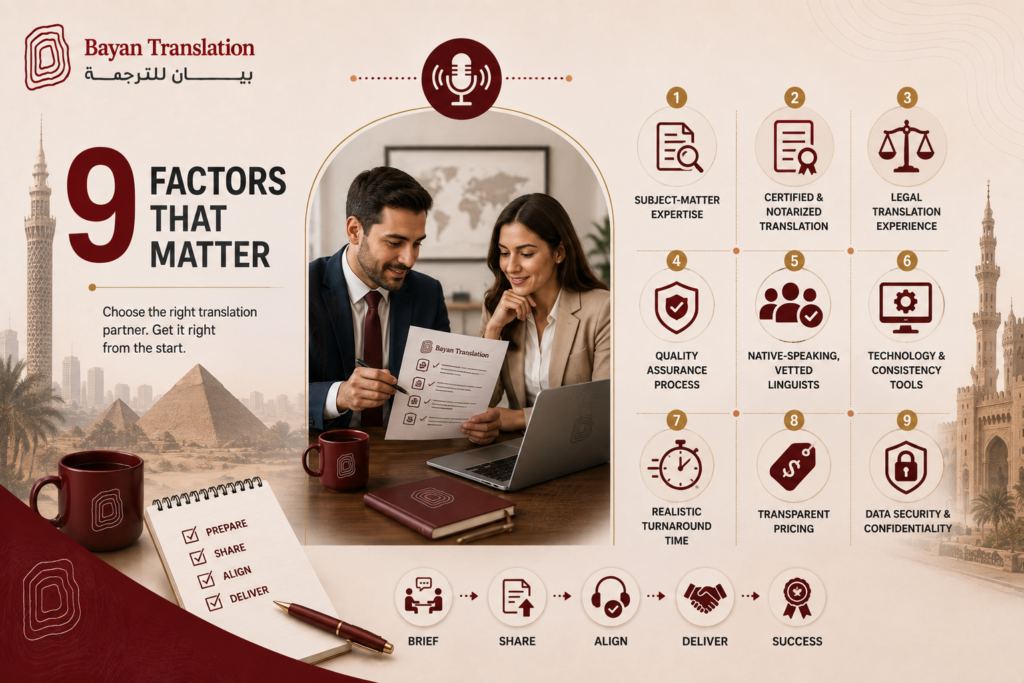
This guide breaks down the nine factors that actually matter, explains the difference between certified translation and legal translation, and gives you a quick checklist before you sign anything.
Table of Contents
- What Does a Translation Agency Actually Do?
- Factor 1: Subject-Matter Expertise
- Factor 2: Certified and Notarized Translation Capability
- Factor 3: Legal Translation Experience
- Factor 4: Quality Assurance Process
- Factor 5: Native-Speaking, Vetted Linguists
- Factor 6: Technology and Consistency Tools
- Factor 7: Turnaround Time
- Factor 8: Transparent Pricing
- Factor 9: Data Security and Confidentiality
- Red Flags to Watch For
- Certified vs. Legal Translation: What’s the Difference?
- Quick Comparison Checklist
- Conclusion
- FAQs
What Does a Translation Agency Actually Do?
A translation agency is more than a middleman who hands your document to a bilingual freelancer. A solid provider manages the entire pipeline: matching your project with a qualified linguist, running quality checks, formatting the final file, and standing behind the result if something needs fixing.
Think of it like hiring a contractor instead of doing your own plumbing. You could find an individual translator yourself, but an agency brings project management, backup linguists, and accountability you won’t get from a single freelancer.
Factor 1: Subject-Matter Expertise
Not all translation services are the same. A translator who’s excellent with marketing copy might struggle with a pharmaceutical data sheet, and vice versa.
Before hiring, ask:
- Does the agency have linguists with real experience in your industry (legal, medical, technical, financial)?
- Can they show sample projects similar to yours?
- Do they use subject-specific glossaries to keep terminology consistent?
A general-purpose professional translation agency can handle a simple business email. A contract, patent filing, or clinical trial document needs someone who already speaks the industry’s language, not just the country’s language.
Factor 2: Certified and Notarized Translation Capability
If you’re submitting documents to USCIS, a university, or a court, you’ll almost certainly need a certified translation — one accompanied by a signed statement attesting to its accuracy and completeness.
Confirm the agency can provide:
- A Certificate of Accuracy with every certified document
- Notarization, if your receiving institution requires it
- Formatting that mirrors the original document layout
This matters more than people expect. Some providers run text through machine translation, slap a certificate on it, and call it done. That shortcut can pass a cursory glance but fail under real scrutiny — and get your application bounced back.
Factor 3: Legal Translation Experience
Legal translation carries higher stakes than most content. A single mistranslated term in a contract, deposition, or patent application can shift liability or void an agreement entirely.
Look for an agency that:
- Employs linguists with legal training or extensive legal-document experience
- Understands jurisdiction-specific terminology (common law vs. civil law systems differ significantly)
- Has a documented review process for legal work specifically
If your document will be read by a judge, regulator, or opposing counsel, this isn’t the place to save money with a generalist provider.
Factor 4: Quality Assurance Process
Ask any agency directly: “What does your QA process look like?” Their answer tells you a lot.
A strong process typically includes:
- Translation by a qualified native-speaking linguist
- Independent editing by a second linguist
- Proofreading for formatting and consistency
- A final review against the source document
If an agency can’t clearly explain their steps, that’s a sign quality control might be an afterthought rather than a built-in process.
Why Certifications Like ISO 17100 Matter
ISO 17100 is an international standard specific to translation services. Agencies certified under it must follow defined processes for translator qualifications, review, and record-keeping. It’s not a guarantee of perfection, but it does mean the agency has committed to a documented, auditable workflow.
Factor 5: Native-Speaking, Vetted Linguists
Fluency isn’t the same as native command of a language. A professional agency should only use linguists translating into their native language — not the other way around.
Also worth checking:
- Are translators credentialed through a body like the American Translators Association (ATA)?
- Does the agency vet translators for both language skill and subject knowledge?
- Is there a consistent linguist assigned to your ongoing projects, or does it change every time?
Consistency matters for brands and businesses with recurring translation needs — the same linguist learns your preferred tone and terminology over time.
Factor 6: Technology and Consistency Tools
Good agencies use translation memory and terminology databases — not to replace human translators, but to keep large or ongoing projects consistent.
- Translation memory (TM) stores previously translated phrases so the same term is translated the same way every time.
- Glossaries and style guides keep brand voice and technical terms aligned across documents.
- Machine translation post-editing (MTPE) can speed up large volumes, but should always involve a human editor for anything official or client-facing.
Ask whether the agency uses MTPE for your project type, and if so, how much human review is involved.
Factor 7: Turnaround Time
Every project has a timeline, and agencies vary widely in how they handle it. Small documents might take a day; large technical manuals can take weeks.
A trustworthy agency will:
- Give you a realistic estimate upfront, not just the fastest possible answer
- Flag if rush service costs extra
- Communicate proactively if a delay is likely
Be wary of guarantees that seem too fast for the complexity of your document — speed shouldn’t come at the cost of accuracy.
Factor 8: Transparent Pricing
Translation pricing usually runs per word, per page, or per hour, and rates shift based on language pair, subject complexity, and urgency.
What to look for:
- A clear, itemized quote before work begins
- No hidden fees for formatting, certification, or file conversion
- Volume discounts disclosed upfront, if applicable
The lowest quote isn’t automatically the best deal. If a price seems far below competitors for the same scope, ask what’s being cut — usually it’s the second-round editing step.
Factor 9: Data Security and Confidentiality
Legal, medical, and financial documents often contain sensitive information. A professional translation agency should treat that seriously.
- Confirm they sign a non-disclosure agreement (NDA) if you request one
- Ask how files are stored and transmitted
- Check whether they comply with relevant data regulations for your industry
If an agency can’t answer basic questions about how your files are protected, that’s worth pausing on.
Red Flags to Watch For
- No sample work or client references available
- Vague answers about who actually performs the translation
- Certification offered without any human review process
- Pricing that’s dramatically lower than every other quote you received
- No dedicated point of contact for your project
- Reluctance to put turnaround and certification details in writing
Certified vs. Legal Translation: What’s the Difference?
These terms get mixed up often, so here’s the short version:
Certified translation refers to any document translation accompanied by a signed statement of accuracy — often needed for immigration, academic, or government submissions.
Legal translation refers to the subject matter — contracts, court filings, patents, and other legal documents — regardless of whether certification is required.
A document can be both: a certified legal translation of a birth certificate for immigration purposes, for example. But not every certified translation is legal in nature, and not every legal translation needs formal certification. Knowing which one (or both) you need helps you ask the right questions upfront.
Quick Comparison Checklist
Before choosing, run each candidate agency through this list:
- [ ] Relevant industry or document-type experience
- [ ] Certified translation with signed accuracy statement, if needed
- [ ] Native-speaking linguists, second-linguist editing step
- [ ] Clear QA process they can explain in plain language
- [ ] Realistic turnaround estimate in writing
- [ ] Transparent, itemized pricing
- [ ] NDA or documented confidentiality policy
- [ ] Sample work or references available on request
Conclusion
Choosing a professional translation agency isn’t about finding the cheapest or fastest option — it’s about finding a partner whose process you can trust with documents that matter. Expertise, certification, quality assurance, and transparency aren’t nice extras; they’re the baseline for avoiding costly mistakes.
Run any agency you’re considering through the checklist above. If they can answer every question clearly and back it up in writing, you’ve likely found a provider worth trusting with your next project.
Ready to get your document translated the right way the first time? Request a free quote from a certified translation specialist today, and find out exactly what your project will cost — no guesswork, no hidden fees.