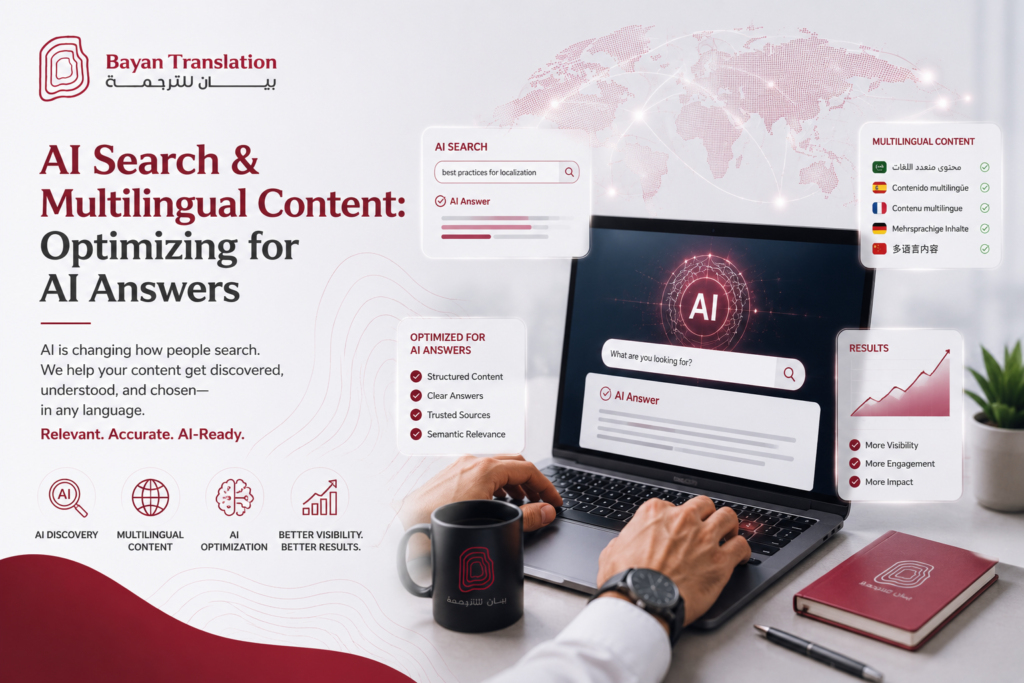
Search is being rewritten in front of us — and the brands that adapt their multilingual content for AI answers now will own visibility that competitors spend years trying to recover. As AI-powered search, chat assistants, and answer engines change how people find information, optimising content so that AI systems cite and surface it — in every language — has become essential. For businesses targeting Arabic and English audiences across Egypt, Oman, and the Gulf, AI search optimisation is the next frontier of digital visibility.
How search is changing
For two decades, search meant a list of blue links. Increasingly, it means a direct answer: AI Overviews in search engines, conversational assistants that synthesise responses, and answer engines that summarise sources rather than sending users to them. In this world, the goal shifts from ranking on a results page to being the source an AI chooses to cite or paraphrase. This is often called AEO (answer engine optimisation) or GEO (generative engine optimisation), and it changes how content must be written and structured.
Why multilingual AI optimisation matters
AI answer engines operate across languages, and Arabic-speaking users are increasingly asking questions of AI assistants in Arabic. If your content exists only in English, or is poorly localised, AI systems are far less likely to surface it for Arabic queries — handing that visibility to competitors who optimised their Arabic content. Because Arabic content remains relatively under-represented online, there is a genuine opportunity for brands that invest early in high-quality, AI-optimised Arabic content to become the cited authority in their niche.
Write for how AI reads content
AI systems favour content that is clear, well-structured, and directly answers real questions. That means leading with concise answers, using descriptive headings that mirror how people ask questions, breaking information into logical sections, and providing definitions and specifics rather than vague marketing prose. Content structured as clear questions and answers, with factual, self-contained passages, is easier for AI to extract and cite. This applies in Arabic as much as in English — and the Arabic must be genuinely well-written, not machine-translated.
Structure, schema, and machine readability
Technical structure helps AI understand and trust your content. Structured data (schema markup) for organisations, articles, FAQs, and products gives machines explicit signals about what your content means. Clean headings, logical hierarchy, and accessible markup make content easier to parse. For multilingual sites, correct hreflang and language markup ensure AI systems associate the right content with the right language and audience. These technical foundations increasingly influence whether AI systems can confidently use your content.
Authority, accuracy, and trust signals
AI systems try to cite sources they can trust, so demonstrable authority matters. Accurate, well-sourced, expert content; clear authorship and organisational credibility; consistency across your web presence; and genuine expertise in your subject all increase the likelihood of being cited. For a translation company, this means publishing genuinely useful, expert content about language and localisation. For any brand, it means being a reliable, authoritative source rather than a thin content mill — because AI, like a careful reader, favours substance.
The role of high-quality localisation
You cannot AI-optimise Arabic content that is poorly translated. AI systems and Arabic-speaking users alike can tell the difference between native-quality Arabic and awkward machine output, and low-quality content undermines both trust and citation. Genuine localisation — native Arabic writing, correct terminology, cultural fit, and the right register — is the foundation on which AI optimisation is built. This is where language expertise and digital strategy meet: the content must be both technically optimised and linguistically excellent.
Measuring AI visibility
AI search optimisation requires new ways of measuring success. Beyond traditional rankings, brands are beginning to track whether and how AI assistants mention or cite them, monitor referral traffic from AI sources, and test how their brand and content appear when questions are posed to popular AI tools in both English and Arabic. This monitoring is still maturing, but paying attention to AI visibility now positions brands to adapt as the tools and metrics evolve.
How Bayan Translation helps
Bayan Translation combines native Arabic linguists with multilingual-SEO and content expertise to create and optimise content that both people and AI systems trust — well-structured, authoritative, genuinely localised Arabic and English content with the technical signals AI engines rely on — helping brands across Egypt, Oman, and the Gulf stay visible as search evolves, under ISO 17100 & ISO 9001 quality.
Getting started with AI search optimisation
Begin by auditing your existing content through an AI lens: does each important page clearly answer the questions your audience actually asks, in both English and Arabic? Prioritise creating genuinely useful, well-structured content on the topics where you have real expertise, ensure your Arabic is native-quality rather than machine-translated, add appropriate structured data, and get your multilingual technical signals right. Then monitor how AI tools reference your brand and refine over time. Starting now — while Arabic AI-optimised content is still relatively scarce — is how brands build durable visibility.
The opportunity for MENA brands
The shift to AI search is not only a challenge to manage but an opportunity to seize. Because high-quality Arabic content is under-represented online, the field is far less crowded than in English, and brands that publish authoritative, well-localised, AI-friendly Arabic content can establish themselves as the cited source in their niche before competitors react. For businesses in Egypt, Oman, and the Gulf, investing in AI search optimisation now is a chance to build a visibility advantage that compounds as AI-driven discovery continues to grow.
FAQ
What is answer engine optimisation? Optimising content so AI answer engines cite or surface it directly, rather than just ranking on a results page.
Does AI search optimisation work for Arabic? Yes — and because quality Arabic content is scarcer, the opportunity to become a cited authority is greater.
Can I just machine-translate my English content? No — AI and users detect low-quality Arabic; genuine localisation is the foundation of AI visibility.
Want to stay visible as search evolves? Request a free quote.