Becoming a certified translator in Egypt is less about a single exam and more about building — and proving — genuine professional competence. For aspiring translators, the path combines language mastery, specialised training, practical experience, and recognised credentials. This roadmap lays out how to build a credible, employable career as a professional translator in Egypt, whether your goal is agency work, freelancing, or official certified translation.
Start with genuine language mastery
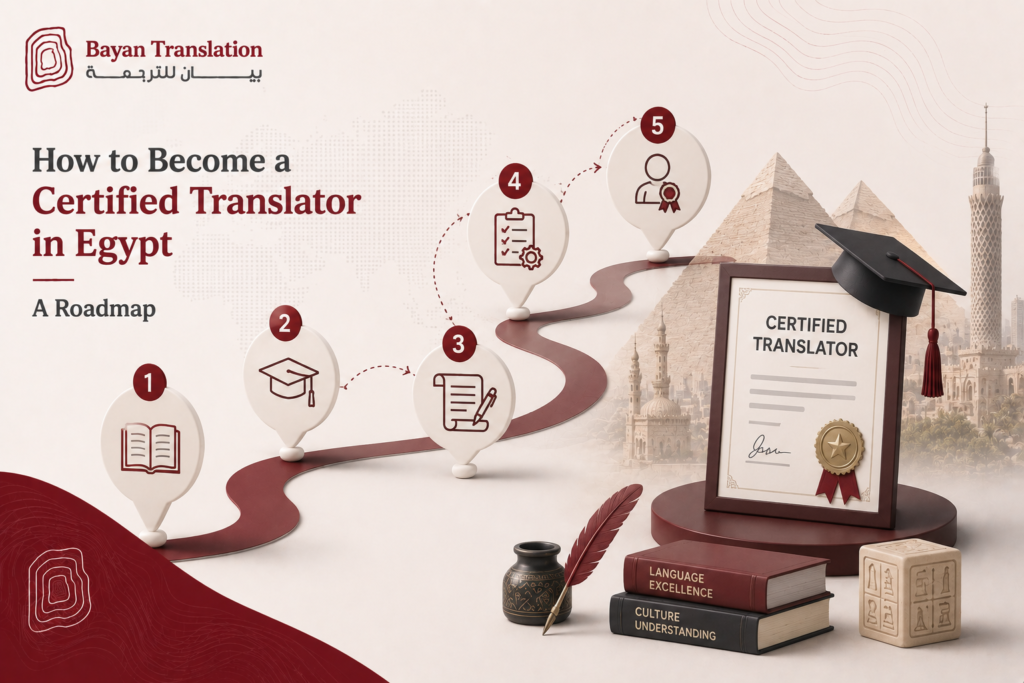
Certification means little without real command of your working languages. A professional translator needs near-native comprehension of the source language and excellent writing ability in the target language — most often Arabic and English in the Egyptian market. This goes well beyond conversational fluency: it means understanding register, idiom, nuance, and the cultural context behind the words. Aspiring translators should read widely in both languages, write constantly, and develop the sensitivity to render not just meaning but tone. Language mastery is the non-negotiable foundation everything else builds on.
Get formal education and training
Most professional translators hold a university degree, commonly in languages, translation, linguistics, or a specific language such as English or Arabic. Egypt’s universities — including well-known faculties of languages and Al-Alsun (languages) programmes — offer translation-focused education that builds both linguistic and theoretical foundations. Beyond a degree, specialised translation courses, diplomas, and workshops develop the practical skills that academic study alone may not, such as translation technology, subtitling, or legal and medical translation techniques. Continuous learning is a hallmark of the profession.
Choose your specialisations
Generalist translators face the most competition and the greatest pressure from technology, while specialists command higher rates and steadier demand. Early in your career, begin developing expertise in one or two fields — legal, medical, technical, financial, or marketing — by studying their terminology, conventions, and subject matter. Specialisation makes you far more valuable, because clients need translators who understand a contract, a clinical protocol, or an engineering manual, not just the language it is written in. Your specialism becomes your professional identity.
Build practical experience
Competence is built by doing. Aspiring translators gain experience through internships, entry-level roles at translation agencies, volunteer translation for NGOs or open projects, and carefully taken freelance work. Every real project develops speed, judgement, and familiarity with client expectations and quality standards. Working within an established agency early on is particularly valuable, because it exposes you to professional workflows, revision by senior linguists, and the discipline of consistent quality — an education that freelancing alone rarely provides.
Master the tools of the trade
Modern translation is a technology-enabled profession. Professional translators use computer-assisted translation (CAT) tools, translation memories, terminology databases, and increasingly AI and machine-translation post-editing workflows. Learning these tools is essential to working efficiently and meeting the expectations of agencies and clients. Familiarity with quality-assurance software, file formats, and subtitling or DTP tools further widens the range of work you can take on. Technology does not replace the translator’s judgement, but fluency with it is now part of the job.
Pursue recognised certification
Certification credentials demonstrate your competence to clients and employers. Options include internationally recognised professional qualifications and memberships, sworn or certified translator status for official documents, and accreditation relevant to legal and governmental work. In Egypt, official and legal translation often requires translators whose work is accepted by courts, embassies, and government bodies, so understanding the requirements for certified and sworn translation in your specialisation is important. Certification is both a signal of quality and, for official work, a practical necessity.
Understand certified and official translation in Egypt
Certified translation — for contracts, certificates, court documents, and official submissions — carries legal weight and specific requirements. Such translations typically must be produced by qualified translators or accredited offices, stamped and attested, and sometimes legalised for use abroad. Translators aiming to work in this area should learn the exact procedures for attestation and legalisation, and often work through or alongside recognised translation offices that are accepted by the relevant authorities. This is a specialism in its own right, with strict accuracy and formatting demands.
Build your professional profile
Finally, treat your career as a business. Develop a professional CV and portfolio, build relationships with agencies, maintain a presence on translator platforms, and cultivate a reputation for reliability and quality. Referrals and repeat clients — earned through consistently excellent, on-time work — are the foundation of a sustainable translation career. Professionalism in communication, deadlines, and confidentiality matters as much as linguistic skill in building lasting client relationships.
How Bayan Translation supports translators and clients
As an established, ISO 17100 & ISO 9001-certified provider, Bayan Translation works with skilled linguists across specialisations and delivers certified and official translation accepted by authorities in Egypt and beyond. Whether you need professional certified translation or a trusted partner for complex projects, Bayan Translation brings over two decades of expertise across Egypt, Oman, and the Gulf.
The realities of the profession
Aspiring translators should enter the field with clear eyes. Translation is intellectually demanding and often deadline-driven, and building a stable income — especially freelancing — takes time and persistence. But it is also a profession with real longevity for those who specialise, keep learning, and deliver consistent quality. As AI handles more routine work, the translators who thrive will be the specialists, the culturally fluent, and the subject-matter experts whose judgement machines cannot replicate. Building genuine competence, rather than chasing a certificate alone, is what creates a durable career in the Egyptian and regional market.
A career worth building well
For those willing to invest in genuine mastery, translation offers a meaningful and lasting profession — one that sits at the intersection of language, culture, and expertise. Follow the roadmap deliberately: build language mastery, gain education and specialisation, accumulate real experience, master the tools, and earn recognised credentials. Do that, and you will not merely hold a certificate; you will be a professional whose skills are in demand across Egypt, Oman, and the wider region for years to come.
FAQ
Do I need a degree to be a translator in Egypt? Most professionals hold a relevant degree, but specialisation, experience, and certification matter just as much.
What is certified translation? Official translation of legal or government documents, produced by qualified translators or accredited offices and attested for official use.
Should I specialise? Yes — specialists earn more and face less competition than generalists.
Need certified translation you can trust? Request a free quote.