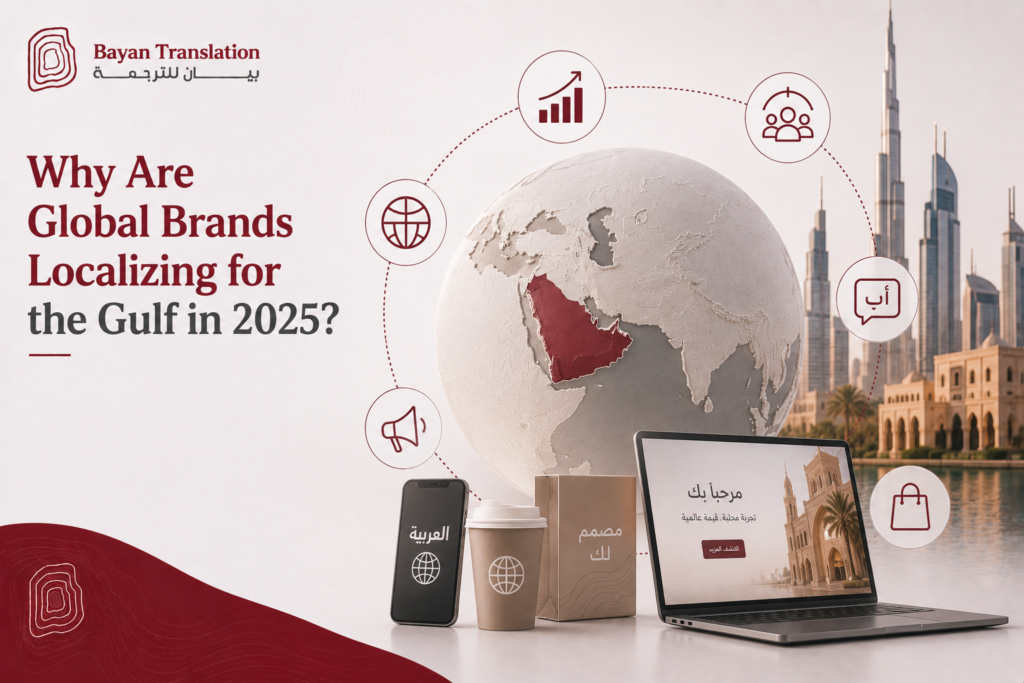
The Gulf has become one of the world’s most attractive markets — and the brands winning there are the ones treating Arabic localisation as strategy, not translation. Across Saudi Arabia, the UAE, Oman, and their neighbours, economic diversification, a young digital-first population, and high purchasing power are drawing global companies in. But the Gulf rewards brands that speak to it natively and quietly penalises those that arrive with English-only or clumsily translated experiences.
Why the Gulf, and why now
Gulf economies are diversifying aggressively away from oil, pouring investment into tourism, entertainment, technology, finance, and retail. The population is young, highly connected, and among the world’s heaviest users of social media and e-commerce, with significant disposable income. For global brands in consumer goods, gaming, streaming, fintech, luxury, and SaaS, that combination is irresistible — and the window to establish presence before competitors do is exactly why localisation activity is accelerating now.
Arabic-first, not Arabic-optional
The biggest shift is the move from offering Arabic as an afterthought to designing Arabic-first experiences. Gulf consumers increasingly expect full Arabic interfaces, content, and support — and studies consistently show people prefer to buy in their own language. Brands that localise their apps, stores, and campaigns properly see higher engagement, trust, and conversion, while those that rely on English or poor machine translation signal that they do not take the market seriously. Localisation has become table stakes for credibility.
Beyond translation: cultural adaptation
Winning in the Gulf means adapting to culture, not just language. Imagery, colours, humour, religious sensitivities, gender norms, local references, and the rhythm of the calendar — Ramadan and Eid shape major commercial moments — all influence how a brand is received. Campaigns that acknowledge and align with local culture build genuine affinity; those that ignore it, or import assumptions from other markets, risk indifference or backlash. Cultural fluency is what separates brands that are tolerated from brands that are loved.
Gulf Arabic and the dialect question
Arabic is not monolithic, and the Gulf has its own dialect (Khaleeji) distinct from Egyptian or Levantine Arabic. Formal content and documentation typically use Modern Standard Arabic, but marketing, social, and voice content often land better in Gulf Arabic, which feels local and personal to the audience. Choosing the right variety for each type of content — and casting Gulf voice talent for audio and video — signals authentic understanding of the market.
What global brands need to localise
- Websites and e-commerce — full Arabic, right-to-left design, local payment and delivery expectations
- Mobile apps — Arabic UI, RTL layouts, and Arabic app-store listings
- Marketing campaigns — transcreated, culturally adapted, dialect-aware
- Social media — native Arabic content on the platforms Gulf audiences use
- Customer support — Arabic-speaking service across channels
- Legal and compliance — Arabic documentation meeting local requirements
Right-to-left design is a technical commitment
Arabic localisation is not just words — it reshapes design. Interfaces must mirror to right-to-left, layouts must accommodate text expansion, fonts must support Arabic shaping, and mixed Arabic-Latin content must render cleanly. Retrofitting RTL onto a product built only for English is costly, so leading brands build internationalisation in early. The visible polish of a properly localised Arabic interface is itself a trust signal to Gulf users.
Common mistakes global brands make
Recurring errors include relying on raw machine translation for customer-facing content, using the wrong Arabic variety, ignoring RTL design, overlooking cultural and religious sensitivities, and localising the product but not the support or marketing around it. Each undermines the investment. The brands that succeed avoid these by partnering with regional language experts from the start rather than treating localisation as a final, rushed step.
How Bayan Translation helps brands win in the Gulf
Bayan Translation localises websites, apps, campaigns, and content for the Gulf and wider MENA region — combining native Gulf and MSA linguists, cultural consultants, transcreation, RTL and multimedia expertise, and certified translation — so global brands arrive in Oman, Saudi Arabia, the UAE, and beyond sounding genuinely local, under ISO 17100 & ISO 9001 quality.
Measuring localisation success in the Gulf
Treat Gulf localisation as an investment with measurable returns. Track Arabic-language traffic and its conversion rate against English, engagement and retention among Gulf users, app-store ratings and reviews in the region, support-ticket volume relating to language, and revenue growth per market. These metrics reveal where localisation is driving results and where it needs deepening, turning localisation from a one-off project into an ongoing growth lever you can optimise over time.
Building a phased localisation roadmap
Few brands can localise everything at once, so sequencing matters. A sensible roadmap starts with the highest-impact, highest-visibility touchpoints — the website, the app, and the flagship campaign — then extends to support, social, and secondary content, and finally to continuous localisation of ongoing updates. Phasing this way delivers early wins and learning while building toward a fully Arabic-first presence, and it lets budget follow demonstrated returns rather than guesswork.
Partnering for the long term
The Gulf is not a market to enter once and forget; audiences, platforms, and expectations evolve quickly. Brands that sustain success maintain an ongoing relationship with a regional language partner who keeps terminology consistent, adapts campaigns to each cultural moment, and scales localisation as the brand grows. That continuity — rather than a series of disconnected translation jobs — is what builds a coherent, trusted Arabic brand presence across Oman and the wider Gulf.
The bottom line for global brands
The Gulf rewards commitment and punishes shortcuts. Brands that invest in Arabic-first experiences, cultural adaptation, the right dialect, and proper RTL execution build trust, engagement, and loyalty that translate directly into revenue. Those that treat localisation as a box to tick arrive sounding foreign and lose ground to competitors who did the work. Getting it right is not just a translation decision — it is a market-entry strategy, and it deserves the same care as any other part of your Gulf expansion.
FAQ
Do I need Gulf Arabic or Modern Standard Arabic? MSA for formal content and documentation; Gulf Arabic often works better for marketing and voice — we advise per project.
Is machine translation enough for the Gulf market? Not for customer-facing content — Gulf audiences quickly notice, and it damages trust.
What should I localise first? Your highest-impact touchpoints — website, app, and flagship campaign — then expand.
Entering the Gulf market? Request a free quote.