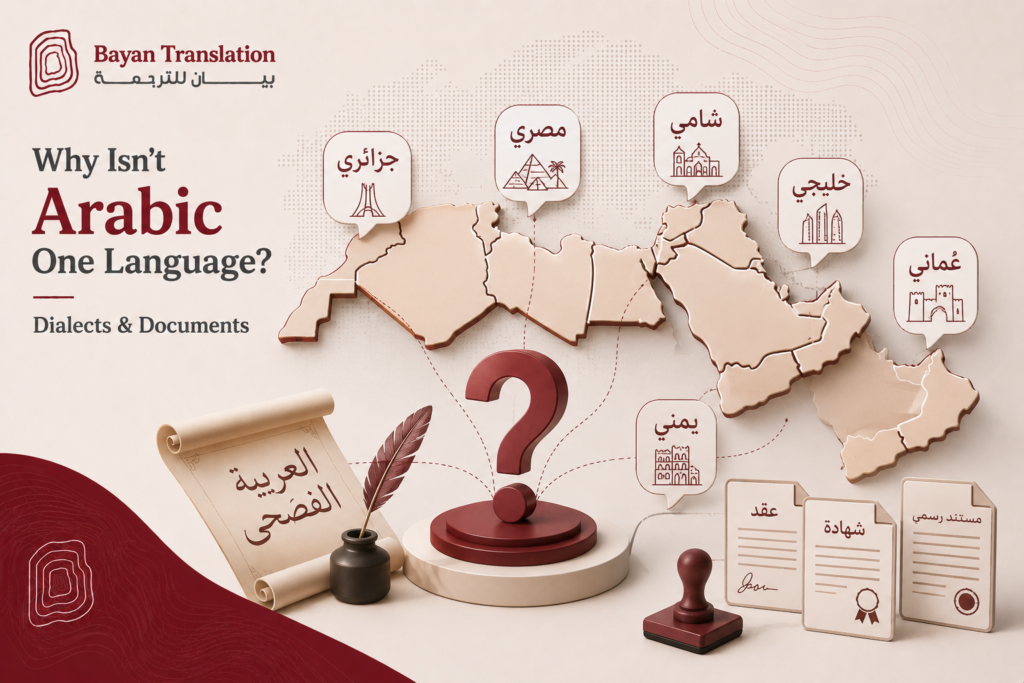
Treating Arabic as a single language is one of the most expensive mistakes a business can make when entering the Arab world. Arabic is really a spectrum — from the formal Modern Standard Arabic used in writing to dozens of spoken dialects that differ so much that speakers from Morocco and Oman may struggle to understand each other. Knowing which “Arabic” you need, and when, is fundamental to communicating credibly across Egypt, Oman, and the Gulf.
Modern Standard Arabic: the written common ground
Modern Standard Arabic (MSA) is the formal, standardised variety used in news, official documents, contracts, books, signage, and most written communication across the entire Arab world. It is nobody’s native spoken language, but it is universally understood by educated Arabic speakers, which makes it the safe default for formal, written, and pan-regional content. Legal documents, corporate communications, user manuals, and official websites are typically produced in MSA precisely because it travels across every Arab country.
The dialects: how people actually speak
Everyday spoken Arabic is a different world. Major dialect groups — Egyptian, Levantine, Gulf (Khaleeji), Iraqi, and Maghrebi among them — differ in vocabulary, pronunciation, grammar, and idiom. Egyptian Arabic is widely understood thanks to Egypt’s film and media reach; Gulf Arabic, spoken across Oman, the UAE, Saudi Arabia, and neighbours, has its own vocabulary and cadence. These are not minor accents: differences can be large enough that a phrase natural in one dialect is confusing or even unintentionally funny in another.
Why the difference matters for business
The register you choose signals how well you understand your audience. Use MSA for a warm, conversational social-media campaign and it can feel stiff and impersonal; use a specific dialect in a formal legal notice and it looks unprofessional. Global brands that localise marketing into the right dialect — Gulf Arabic for the Gulf, Egyptian for Egypt — connect far more effectively than those that default to one-size-fits-all MSA. Matching variety to context is a mark of respect that audiences notice.
When to use MSA
- Legal, court, and government documents
- Official corporate communications and reports
- Contracts, policies, and technical manuals
- Content intended to reach all Arab countries at once
- News, formal articles, and signage
When to use a dialect
- Advertising and marketing campaigns targeting a specific country
- Social-media content and influencer copy
- Voice-overs, dubbing, and character dialogue
- Customer-service scripts for a particular market
- Any content where warmth and relatability matter more than formality
Documents, dialect, and diglossia
Linguists call the coexistence of a formal written variety and everyday spoken varieties “diglossia”, and it has practical consequences. A single project may need MSA for the written contract and Gulf Arabic for the accompanying explainer video; an app might use MSA for its interface and dialect for its marketing. Handling this well requires linguists who know both the standard language and the target dialect, and who can advise which to use where — decisions that automated tools and non-native reviewers routinely get wrong.
The Arabic script adds its own layer
Beyond dialect, written Arabic brings right-to-left formatting, cursive letter-shaping, optional diacritics, and mixed-direction handling for embedded numbers and Latin text. These technical factors affect documents, subtitles, websites, and design alike, and they must be handled correctly regardless of which spoken variety underlies the content. Language choice and technical execution together determine whether Arabic content looks native or amateurish.
How Bayan Translation gets Arabic right
Bayan Translation’s native linguists cover Modern Standard Arabic and the region’s dialects — Gulf Arabic for Oman and the Gulf, Egyptian Arabic, and more — and advise which variety fits each document, campaign, or audience. From certified legal MSA to dialect marketing and dubbing, we ensure your Arabic is not just correct but appropriate, backed by ISO 17100 & ISO 9001 quality.
Numbers, dates, and cultural conventions
Arabic variation extends beyond words into conventions that quietly affect professionalism. Number systems (Eastern vs Western Arabic numerals), date formats, currency, and honorifics vary by country and context, and getting them wrong marks content as foreign even when the translation is technically correct. Native linguists apply the conventions your target audience expects — another reason human, region-aware translation matters for anything customer-facing.
How dialect choice affects voice and video
Nowhere does dialect matter more than in spoken content. A voice-over or dubbed video in the wrong dialect immediately signals that content was not made for this audience, while the right dialect builds instant rapport. For campaigns targeting Oman and the Gulf, Gulf Arabic voice talent lands very differently from Egyptian or Levantine. Casting the right voice and dialect is a creative decision that directly shapes how audiences receive your brand.
The bottom line for global brands
The practical takeaway is simple: there is no single “Arabic translation” that fits every need. Formal written content wants MSA; market-specific marketing and spoken content want the appropriate dialect; and every project needs correct script handling. Working with a partner who understands this spectrum — and who advises rather than defaults — is what turns Arabic content from merely accurate into genuinely effective across the Arab world.
Getting Arabic variety right, every time
The safest approach is to decide variety deliberately at the start of every project rather than defaulting out of habit. Map each piece of content to its purpose and audience, choose MSA or the appropriate dialect accordingly, and brief your linguists on the intended tone and market. Combined with correct right-to-left formatting and local conventions, this discipline ensures your Arabic content is not only accurate but genuinely resonant — reading as though it was created by and for the people you are trying to reach across Egypt, Oman, and the Gulf.
FAQ
Should my Arabic website be in MSA or dialect? Usually MSA for the core content, with dialect for market-specific marketing — we advise per project.
Will Gulf readers understand Egyptian Arabic? Often yes, but for marketing, localising into the target dialect connects far better.
Are legal documents always in MSA? Yes — formal, legal, and official documents use Modern Standard Arabic.
Need Arabic that fits your audience exactly? Request a free quote.