

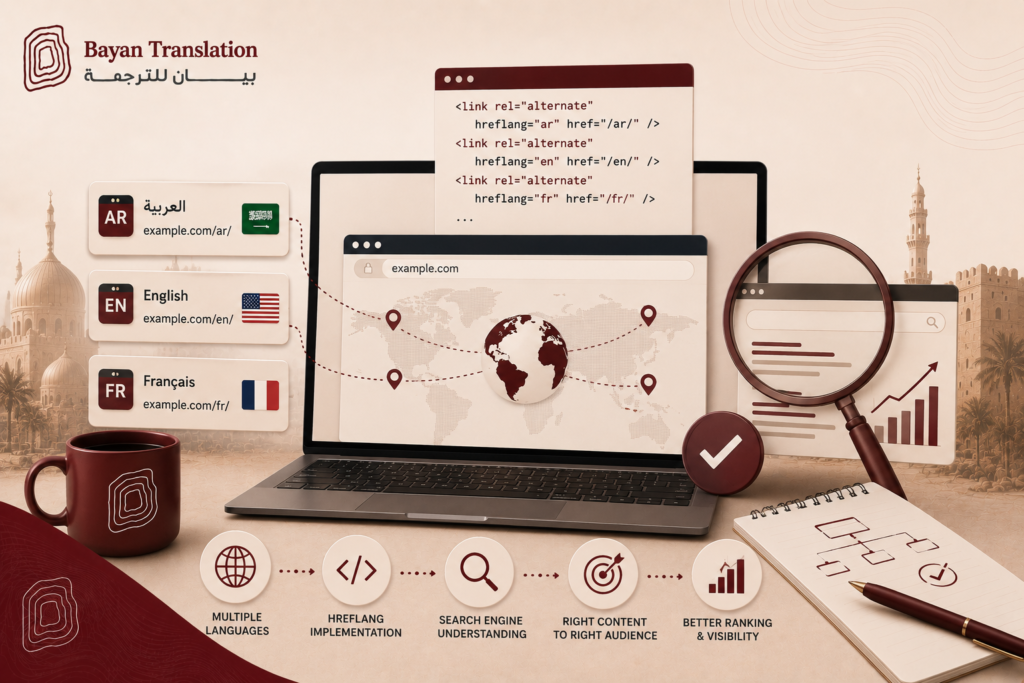
Hreflang is the small piece of code that decides whether an Arabic speaker in Cairo sees your Arabic page or your English one — and getting it wrong quietly wastes every dinar you spend on multilingual content. For any business serving both Arabic and English audiences across Egypt, Oman, and the Gulf, correct hreflang implementation is the difference between search engines confidently serving the right language to the right user and them guessing, duplicating, or suppressing your pages.
What hreflang actually does
Hreflang is an HTML attribute (or an equivalent XML-sitemap or HTTP-header entry) that tells search engines which language and regional version of a page to show a given user. It signals, for example, that this URL is the Arabic version for readers in Egypt, that one is the English version, and that a third serves Arabic readers in the Gulf. Without it, Google may treat your Arabic and English pages as duplicates, rank the wrong one, or split their authority — undermining the whole point of investing in localisation.
The correct syntax and language codes
Each page in a language set must reference every version, including itself. The value combines an ISO 639-1 language code with an optional ISO 3166-1 region code: ar for Arabic, ar-EG for Arabic in Egypt, ar-OM for Arabic in Oman, en for English, and x-default for the fallback shown when no other version fits. A common, costly mistake is inventing codes or using country codes where language codes belong — search engines silently ignore malformed tags, so the error is invisible until traffic never arrives.
The three cardinal rules
- Reciprocity: if page A points to page B, page B must point back to page A. One-directional tags are ignored.
- Self-reference: every page must include an hreflang tag pointing to itself.
- Absolute URLs: always use full, canonical URLs including the protocol — never relative paths.
Break any one of these and the entire cluster can fail, because hreflang is evaluated as a connected set, not page by page.
Hreflang and canonical tags must agree
A frequent conflict occurs when the Arabic page carries a canonical tag pointing to the English version. That tells Google “this page is a duplicate of the English one” — directly contradicting the hreflang signal that it is a distinct Arabic page. Each language version should canonicalise to itself. When canonical and hreflang disagree, search engines trust the canonical and your localised page disappears from results.
RTL, encoding, and the Arabic-specific pitfalls
Arabic adds wrinkles beyond the tag itself. Ensure your pages declare UTF-8 encoding and the correct lang="ar" and dir="rtl" attributes on the HTML element, so browsers and crawlers render and interpret the content correctly. Mixed-direction content — Arabic text with embedded English brand names, numbers, or URLs — must be handled with proper markup so it displays cleanly. These on-page signals reinforce hreflang and improve both ranking and user experience.
Where to implement it
You can place hreflang in one of three locations — the HTML <head>, the XML sitemap, or the HTTP header — but never mix approaches for the same set, as conflicting signals cause errors. For large multilingual sites, the XML-sitemap method is often cleanest and easiest to maintain; for smaller sites, head tags are simplest. Whichever you choose, apply it consistently across every page in every language.
Testing and monitoring
After implementation, validate with a dedicated hreflang testing tool and monitor the International Targeting and page-indexing reports in Google Search Console, which flag missing return tags and unknown language codes. Hreflang is not set-and-forget: every time you add, move, or delete a localised page, the tags across the set must be updated, or the reciprocity chain breaks.
Why this matters for Egypt and Oman businesses
Companies targeting bilingual MENA audiences often produce excellent Arabic content that never ranks, simply because the technical signalling is wrong. Correct hreflang ensures your Arabic pages capture Arabic searches and your English pages capture English ones — maximising the return on the content you have already paid to create, and presenting a professional, native experience to every visitor.
How Bayan Translation helps
Bayan Translation combines native Arabic linguists with multilingual-SEO specialists to localise your content and implement the technical signals — hreflang, canonicals, RTL markup, and Arabic keyword optimisation — that make it rank across Egypt, Oman, and the Gulf, under ISO 17100 & ISO 9001 quality.
Common hreflang mistakes that quietly cost traffic
In practice, a handful of errors account for most failed implementations. Missing return tags — where one page references another but the favour is not returned — invalidate the pair. Using an underscore instead of a hyphen (ar_EG rather than ar-EG) makes the tag unreadable. Pointing to redirected or 404 URLs wastes the signal entirely. Mixing region codes with language codes, or inventing non-standard codes, causes search engines to ignore the entry. And forgetting the self-referencing tag breaks the set. Because none of these throw a visible error, they can persist for months, silently sending Arabic searchers to your English pages and vice versa.
Hreflang for subdomains, subfolders, and ccTLDs
Your site structure shapes how hreflang is applied. Many MENA businesses run language variants as subfolders (/ar/ and /en/), which is generally the easiest structure to maintain and consolidate authority. Others use subdomains or country-specific domains. Hreflang works with all of them, but the tags must reference the exact live URLs of each variant, and the structure should stay consistent so the reciprocity chain never breaks when new pages are added. Deciding structure early — before you scale content — saves painful re-work later.
A simple implementation workflow
Start by mapping every page to its language and regional counterparts in a spreadsheet. Generate the hreflang set for each cluster, ensuring reciprocity and self-references. Implement via one method — head, sitemap, or header. Validate with a testing tool, then monitor Search Console for errors over the following weeks. Finally, build hreflang updates into your content process, so every new or moved page automatically triggers a review of its language set. Treat it as ongoing hygiene, not a one-off project.
FAQ
Do I need a region code like ar-EG, or is ar enough? Use plain ar unless you serve genuinely different content per country; add region codes only when the versions differ.
Can hreflang fix duplicate-content problems? Yes — it tells search engines the pages are language variants, not duplicates, provided canonicals agree.
Where should I put the tags? Head, sitemap, or HTTP header — pick one method and apply it consistently.
Want your Arabic pages to actually rank? Request a free quote.