

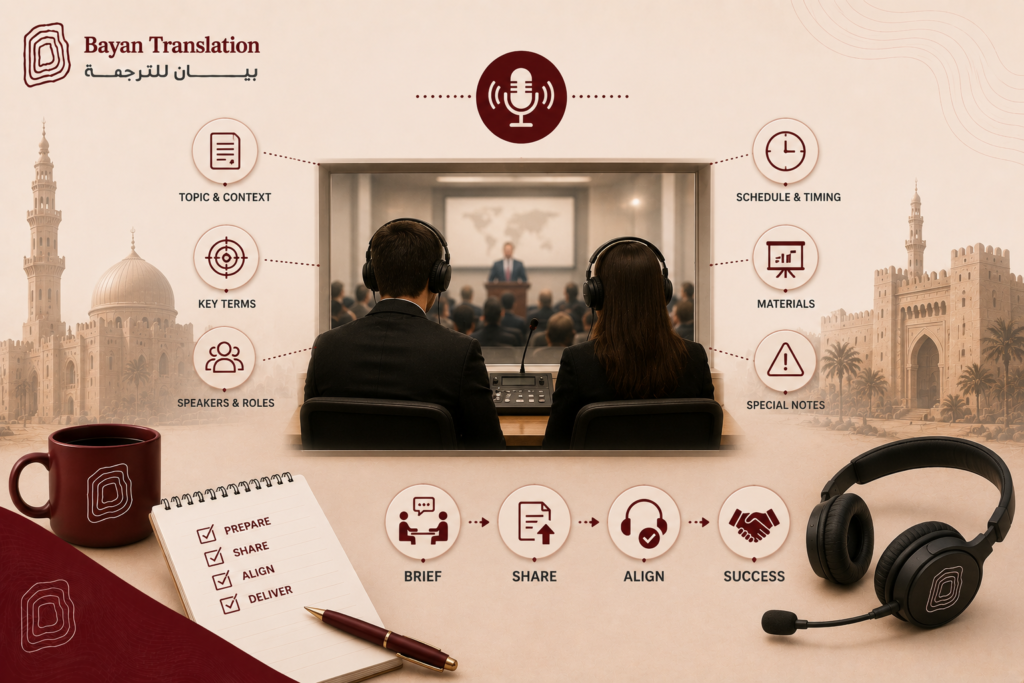
The quality of conference interpretation is decided before the event even starts — in the brief. Even world-class simultaneous interpreters cannot perform at their best if they walk in cold. A short, structured briefing is the single highest-return thing an organiser can do to guarantee a smooth multilingual event, and skipping it is the most common reason otherwise well-run conferences suffer awkward, error-prone interpretation.
Why briefing your interpreters matters
Interpreters render meaning in real time, often with less than a second’s delay. To do that accurately they must anticipate terminology, names, acronyms, and the flow of the agenda. Without preparation, even fluent interpreters hesitate on company-specific jargon, unfamiliar proper nouns, or a sudden change of topic — and your audience feels every stumble. Preparation is not a courtesy to the interpreter; it is what protects your message and your speakers.
What to send interpreters in advance
- Agenda and running order — including timings, session topics, and any changes.
- Speaker list — names, titles, organisations, and correct pronunciation.
- Slides and scripts — even draft versions help; final versions the moment they exist.
- Glossary — product names, acronyms, technical terms, and preferred terminology in both languages.
- Background material — previous reports, press releases, or technical documents.
- Logistics — booth setup, language pairs, and whether sessions are on-site, remote, or hybrid.
Simultaneous vs consecutive: brief accordingly
Simultaneous interpretation — delivered from soundproof booths with headsets while the speaker talks — needs full materials early, because there is no pause for the interpreter to catch up. Consecutive interpretation — where the speaker pauses and the interpreter renders each segment — allows slightly more flexibility but still benefits from the same preparation. Tell your provider which mode you need, and for which sessions, so they can resource and prepare correctly.
Equipment and room setup
For simultaneous work, interpreters need ISO-compliant booths or a reliable remote platform, clean audio feeds, and clear line of sight to the speaker and the screen. Poor sound is the single biggest cause of interpretation errors — an interpreter cannot render what they cannot clearly hear. Investing in proper equipment and a technician on site is the foundation of accurate interpretation.
Remote and hybrid interpretation
Remote simultaneous interpretation (RSI), video remote interpreting (VRI), and over-the-phone interpreting (OPI) have made multilingual meetings more flexible and cost-effective, but they raise the stakes on connectivity and audio quality. For remote or hybrid events, test the platform, the audio routing, and the interpreters’ access well in advance, and have a fallback plan for connection issues.
Day-of best practices
- Give interpreters 15 minutes with the AV team before doors open to test sound and screens.
- Ask speakers to talk at a measured pace and to read out acronyms in full at least once.
- Share any last-minute slide or agenda changes immediately.
- Provide water and scheduled breaks — simultaneous interpretation is intense work, and interpreters typically rotate every 20–30 minutes.
- Have a named point of contact the interpreters can reach during the event.
Choosing the right interpreters
Beyond language fluency, conference interpreters should have subject-matter familiarity, relevant experience, and — for official or legal settings — the appropriate certification. Booking early matters: specialist language pairs and experienced interpreters are in high demand and book out well ahead of major events.
How Bayan Translation delivers conference interpretation
Bayan Translation provides simultaneous, consecutive, and remote (VRI/OPI) interpretation for conferences, legal proceedings, and executive meetings across Egypt and Oman — with certified interpreters, full equipment packages, technical support, and a structured pre-event briefing built into every engagement, so your event runs seamlessly in every language.
Interpretation modes at a glance
Beyond the two classic modes, several delivery formats now exist, and choosing the right one shapes both cost and experience. Simultaneous suits large conferences, keynotes, and multi-track events where flow cannot pause. Consecutive fits smaller settings — negotiations, interviews, medical or legal appointments, and site visits — where turn-taking is natural. Whispered (chuchotage) works when only one or two delegates need interpretation in a larger room. Remote and hybrid formats extend all of these across geographies. Matching the mode to the setting is the first decision, and a good language partner will advise rather than simply take the order.
Confidentiality and professionalism
Conference interpreters routinely handle sensitive commercial, legal, and governmental discussions. Professional interpreters work under strict confidentiality and a code of ethics, and for high-stakes events you should confirm that non-disclosure agreements are in place and that the interpreters have relevant sector experience. Discretion is part of the service, not an optional extra — the interpreter is, for the duration of your event, an extension of your organisation.
Why preparation is the organiser’s best investment
None of this works without lead time. The organisations that run flawless multilingual events are the ones that book early, share materials generously, and treat their interpreters as partners in the event’s success rather than a commodity booked at the last minute. A one-hour briefing and a shared glossary can be the difference between an event that flows and one that stumbles — a remarkably small investment for a large return in clarity and professionalism.
A quick pre-event checklist for organisers
In the final week, confirm the essentials: interpreters booked and briefed for every session and language pair; agenda, slides, speaker names, and glossary sent; booths, headsets, and audio feeds tested (or the remote platform trialled end to end); a technician and a named coordinator on hand; speakers reminded to pace themselves and spell out acronyms; and breaks scheduled so interpreters can rotate. Tick these off and your multilingual event will run smoothly, letting every delegate follow every word in their own language.
FAQ
How early should we book interpreters? As early as possible — specialist language pairs and equipment book out fast.
Do you provide the booths and headsets? Yes, full equipment packages and on-site technical support are available.
Can you support remote or hybrid events? Yes — we deliver remote simultaneous interpretation and VRI/OPI with tested platforms.
Planning a multilingual event? Request a free quote.