Game localization for the MENA region is where many international studios stumble — and where the ones that get it right win lasting loyalty. Arabic is not a drop-in language: it runs right-to-left, expands and contracts unpredictably, and carries cultural sensitivities that can turn a hit game into a public-relations problem overnight. Reaching the Gulf and North African gaming market — one of the fastest-growing and highest-spending in the world — takes far more than translating strings.
Why MENA is too big to ignore
The Middle East and North Africa is among the most engaged and highest-spending gaming regions globally, led by Saudi Arabia, the UAE, Egypt, and a fast-rising Oman. Players increasingly expect a fully Arabic experience — interface, dialogue, and support — and reward studios that localise properly with loyalty, word of mouth, and spend. Studios that ship English-only or machine-translated Arabic leave that engagement on the table and hand it to competitors who took localisation seriously.
Right-to-left is a design problem, not just a text problem
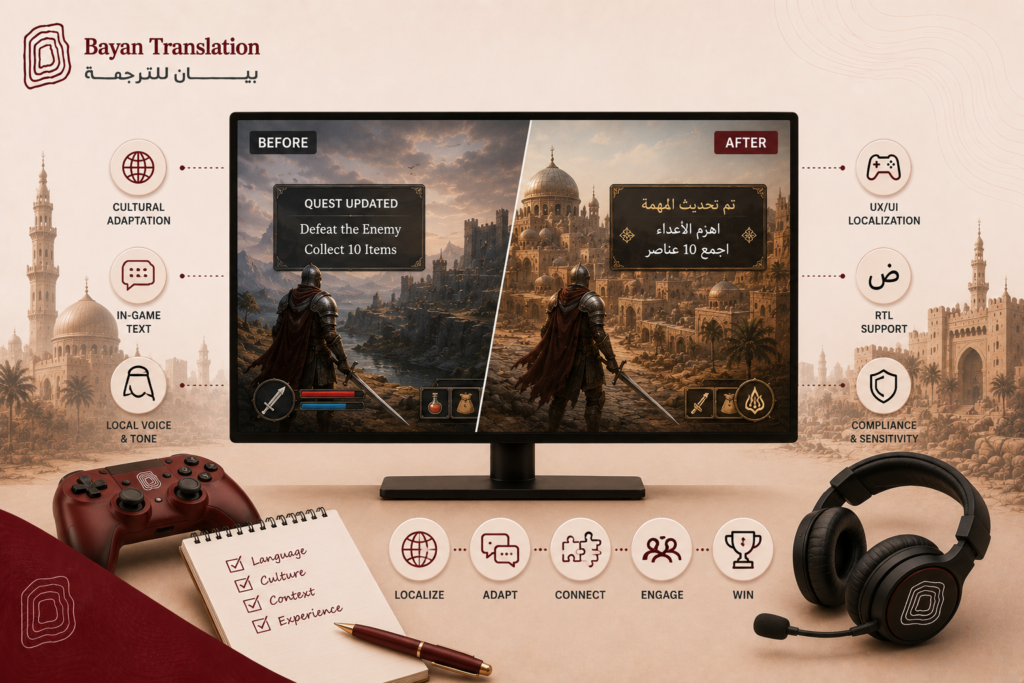
Arabic flips the entire interface. Menus, HUDs, progress bars, and navigation must mirror to right-to-left; text must connect cursively because Arabic letters change shape depending on position; and fonts must support full Arabic shaping and diacritics. Hard-coded layouts and bitmap text break instantly. The earlier RTL is planned into your UI architecture, the cheaper localisation becomes — retrofitting it after the game is built is one of the most expensive mistakes a studio can make.
Text expansion and the UI it breaks
Arabic strings can be significantly longer or shorter than their English source, so buttons, tooltips, subtitles, and dialogue boxes that look perfect in English overflow or truncate in Arabic. Building flexible, resizable UI containers, avoiding text baked into images, and testing with real translated strings — not placeholder Latin text — saves expensive rework late in the cycle.
Cultural adaptation: the make-or-break layer
Beyond language, MENA localisation means culturalisation — reviewing imagery, symbols, gestures, storylines, and references for cultural and religious sensitivity. What is neutral in one market can be offensive in another, and a single misstep can trigger store removals, negative reviews, or viral backlash. A dedicated culturalisation pass, performed by native specialists who understand the region, protects your brand, your ratings, and your revenue.
Dialect and register matter
Modern Standard Arabic works well for menus, systems text, and formal content, but character dialogue often lands better in a regional flavour that feels authentic to players. Choosing the right register for your audience — and keeping it consistent across the game — is a creative decision, not a mechanical one, and it materially affects how immersive and relatable the experience feels.
Audio, voice-over, and subtitles
If your game features voice acting, Arabic voice-over and lip-sync considerations add another layer, as do subtitles that must respect reading-speed limits and RTL rendering. Coordinating text, audio, and on-screen graphics so they align in the localised build is where multimedia expertise pays off.
Testing: linguistic and cultural QA on real builds
Localisation is not finished when the strings are translated. In-context linguistic QA on actual builds catches overflow, truncation, broken shaping, mis-timed subtitles, and context errors that are invisible in a spreadsheet. A cultural QA pass provides a final safeguard against sensitive content before launch.
Do not forget the store and the marketing
Players discover your game through store listings, trailers, and ads. Localising the game but leaving the store page, screenshots, and marketing in English undercuts the whole effort. Full MENA localisation extends to app-store optimisation, trailers, and campaign creative adapted for the region.
A practical localisation checklist
- Externalise all strings; never bake text into textures.
- Design UI for RTL mirroring and significant text expansion from day one.
- Use fonts with full Arabic shaping support.
- Plan a cultural-review pass alongside linguistic QA.
- Choose the right dialect for dialogue and keep it consistent.
- Localise store listings, trailers, and marketing — not just the game.
- Run in-context LQA on real builds before launch.
How Bayan Translation supports game studios
Bayan Translation combines native Arabic linguists, RTL and UI expertise, cultural consultants, and multimedia, subtitling, and voice-over capability to localise games for Egypt, Oman, and the wider Gulf — with ISO 17100 & ISO 9001 quality and full confidentiality under NDA, from first string to store launch.
Budgeting and timelines: plan localisation early
The single biggest driver of localisation cost is when you start. Studios that treat Arabic as an afterthought — bolting it on after the UI, art, and audio are locked — pay a premium to retrofit RTL layouts, re-export baked-in text, and re-record audio. Studios that build internationalisation (i18n) into the engine from day one localise faster and cheaper, because strings are externalised, layouts are flexible, and the pipeline is ready to receive translated content. Treat localisation as a production track that runs alongside development, not a phase tacked on at the end.
Ongoing content and live-service games
Modern games are rarely finished at launch. Live-service titles ship seasons, events, battle passes, and patches, each carrying new strings that need localising on the same cadence as the English release — ideally simultaneously, so Arabic-speaking players are never left behind. This calls for a continuous localisation workflow with a stable translation memory and glossary, so terminology stays consistent across years of updates and every new linguist inherits the established voice of your game.
Measuring localisation success
Once your localised build is live, track the metrics that show whether the investment is working: Arabic-language downloads and their share of total installs, retention and session length among Arabic-speaking players, store-review sentiment in the region, and support-ticket volume relating to language or display issues. These signals tell you where the localisation is delighting players and where it still needs refinement, turning localisation from a one-time cost into a measurable growth lever for the MENA market.
FAQ
Do you handle in-game text, voice, and store listings? Yes — end to end, including subtitling, voice-over, and marketing localisation.
Can you advise on cultural risks before launch? Yes; our culturalisation review flags issues early, before they reach players.
Should dialogue be in dialect or Modern Standard Arabic? It depends on your audience and content — we advise per project.
Planning a MENA launch? Request a free quote and localise it the right way.