
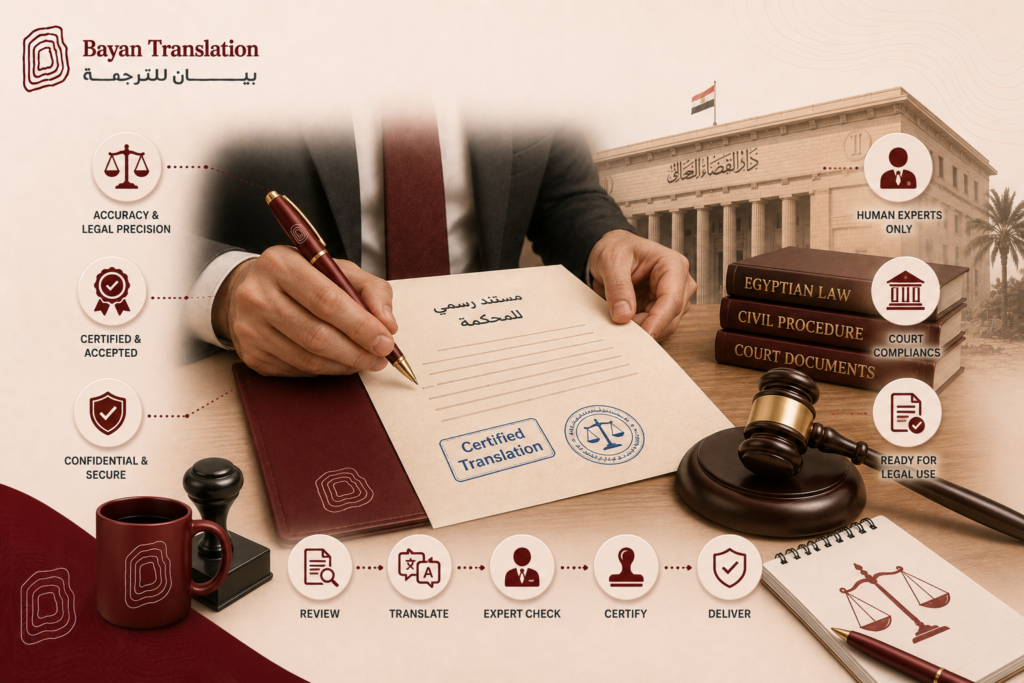
Legal translation in Egypt is not ordinary translation with legal words sprinkled in. A single mistranslated clause in a contract, judgment, or power of attorney can shift liability, invalidate an agreement, or lose a case. For law firms, corporate legal departments, and businesses dealing with Egyptian courts, court-ready legal translation is a specialist discipline — and treating it as an interchangeable commodity is one of the most expensive mistakes a legal team can make.
Why legal translation is uniquely high-risk
Legal language is precise by design. Terms such as “shall”, “indemnify”, “without prejudice”, “consideration”, or “force majeure” carry specific legal weight, and their Arabic equivalents must reflect Egyptian legal concepts rather than a literal word-for-word swap. Legal systems differ too: a doctrine that exists in common law may have no direct counterpart in Egypt’s civil-law framework, so the translator must render the legal effect, not merely the words. Get the effect wrong and the translated document may say something the original never intended.
What “court-ready” actually means
A court-ready translation is one a judge, notary, or government body will accept without question. In Egypt that typically requires a certified translation with a signed accuracy statement; faithful reproduction of every stamp, seal, and signature block; consistent legal terminology throughout the entire file; and formatting that mirrors the original document. Anything less risks rejection, delay, or a challenge to the document’s validity at the worst possible moment.
Documents that demand legal specialists
- Contracts, agreements, and memoranda of understanding
- Court judgments, pleadings, and full case files
- Powers of attorney and notarised declarations
- Company bylaws, commercial registry, and incorporation papers
- Litigation evidence, witness statements, and expert reports
- Compliance, regulatory, and arbitration documents
- Intellectual property filings and licensing agreements
The hidden cost of getting it wrong
A cheap or rushed legal translation can lead to a rejected filing, a bilingual contract whose two versions disagree, or evidence excluded for inaccuracy. Any of these can cost far more than the translation itself — a lost case, a void agreement, a missed deadline, or a dispute over which language version governs. In cross-border contracts, ambiguity introduced in translation is a common source of expensive litigation.
Terminology consistency and the bilingual-contract trap
In legal work the same concept must use the same term throughout a document and across the entire matter. When a contract exists in both Arabic and English, discrepancies between the versions create ambiguity that opposing counsel will exploit. A disciplined legal translation process — supported by a managed glossary and a second-linguist review — keeps the two versions aligned and defensible.
Confidentiality is non-negotiable
Legal documents are among the most sensitive material a business handles. Legal translation must be performed under strict confidentiality, with signed NDAs and secure file handling — and never routed through public, consumer AI tools that may retain your data. Data security is part of legal quality, not an optional extra.
How to choose a legal translation partner
- Confirm certification standards (ISO 17100 & ISO 9001) and a mandatory second-linguist revision step.
- Ask whether legal work is handled by translators with genuine legal subject-matter expertise.
- Check that the provider guarantees confidentiality and signs NDAs.
- Verify that their certified translations are accepted by Egyptian courts and notary offices.
- Ask how they manage terminology consistency across a matter.
Certified vs notarised legal translation
Certification attests that the translation is accurate and complete; notarisation is a separate legal act performed by a notary. Many court and official submissions require certification, and some also require notarisation. A knowledgeable partner tells you which applies before you submit — sparing you a rejected filing.
How Bayan Translation approaches legal & court translation
Bayan Translation handles legal and court documents through vetted legal-specialist linguists, a mandatory two-stage review, managed terminology, and certified accuracy statements accepted across Egypt and Oman. Every file is treated as strictly confidential and protected by signed NDAs, and our ISO 17100 & ISO 9001 processes mean court-ready output on every project — with guidance on certification and notarisation where required.
Machine translation has no place in legal work — on its own
AI and machine translation can accelerate a first draft of low-risk material, but legal documents are the last place to trust unedited automated output. A mistranslated liability clause or a subtly wrong legal term can be catastrophic, and feeding confidential legal files into public AI tools is a serious data-security breach. Where technology is used at all, it must sit inside a secure, controlled workflow with expert human revision — never as a shortcut around qualified legal linguists.
Sworn translation and cross-border recognition
Jurisdictions recognise legal translations in different ways — through accredited companies, sworn translators, or notarisation. When a document crosses borders, the requirements multiply: what satisfies an Egyptian court may differ from what a foreign embassy or a Gulf authority expects, and some destinations require an apostille or consular legalisation on top of translation. A partner who understands these layered requirements ensures your document is recognised wherever it needs to go, the first time.
Speed and accuracy must coexist
Legal deadlines are unforgiving, but in legal translation speed can never come at the expense of accuracy. The right partner resources specialist teams and parallel review to meet tight timelines while preserving the mandatory revision step — so you are never forced to choose between fast and correct on a filing that matters.
Legal translation is risk management
Ultimately, legal translation is a form of risk management. The right partner does not just convert words — they protect your position, your compliance, and your confidentiality at every step. Treating it as a strategic safeguard rather than a line-item cost is what separates legal teams that clear filings smoothly from those that fight avoidable disputes.
Frequently asked questions
Do you provide certified legal translations accepted by Egyptian courts? Yes — our certified legal translations include a signed accuracy statement and faithful reproduction of all official marks.
Can you handle urgent litigation deadlines? Yes; we scale specialist teams for time-critical filings while preserving the mandatory review step.
How do you keep bilingual contracts aligned? Through managed terminology and a dedicated review that checks both versions against each other.
Is confidentiality guaranteed? Always — every legal engagement is covered by an NDA and secure handling.
Need court-ready legal documents? Request a free quote from Bayan Translation’s legal translation specialists.