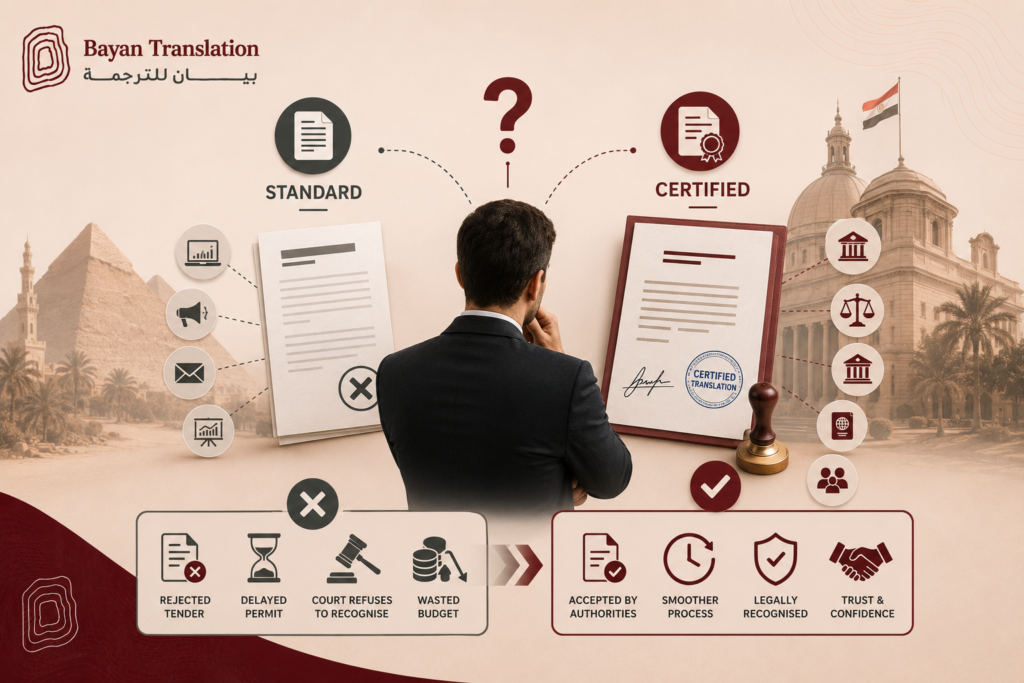
If your company operates in Egypt and deals with government bodies, courts, banks, embassies, or international partners, one question comes up constantly: do you need a certified translation, or is a standard translation enough? Getting this wrong is expensive — a rejected tender, a delayed work permit, a contract a court refuses to recognise, or budget wasted certifying documents that never needed it. This guide explains the difference in plain language, walks through the certification process in Egypt, and shows exactly when each type is required.
What is a standard translation?
A standard translation is an accurate, professional rendering of your text from one language into another — without any official stamp, seal, or signed declaration of accuracy. The quality can be excellent; what it lacks is the legal attestation that the translation is true and complete. Standard translation is the right choice for internal documents, marketing material, website content, presentations, correspondence, and anything that will never be submitted to an official authority. For this kind of content, paying for certification adds cost and time without adding value.
What is a certified translation?
A certified translation is accompanied by a signed and stamped statement — issued by an accredited translation company or a sworn translator — attesting that the translation is a faithful and complete reproduction of the original. In Egypt, this attestation is what allows a document to be accepted by ministries, courts, notary offices (الشهر العقاري), universities, embassies, and licensing bodies. Because the provider puts its name and legal liability behind the work, certified translation is held to a stricter accountability standard and follows a more rigorous review-and-verification workflow.
The key differences at a glance
- Attestation: standard = none; certified = signed and stamped accuracy statement.
- Acceptance: standard = internal and commercial use; certified = official, legal, and government use.
- Accountability: certified translations carry documented liability and a traceable, accredited provider.
- Process: certified work follows a stricter translate-revise-verify workflow (ISO 17100 & ISO 9001 at Bayan Translation).
- Turnaround & cost: certification adds a verification and stamping step, so plan slightly more time and budget.
- Format: certified translations faithfully reproduce every stamp, seal, signature, and marginal note on the original.
When Egyptian businesses need a certified translation
You will almost always need certification for official and legal purposes, including:
- Company incorporation, commercial registry, and licensing documents
- Contracts, agreements, and powers of attorney submitted to a notary
- Tender and procurement files for government entities
- Bank, financial, and compliance documentation
- Immigration, visa, and work-permit paperwork
- Academic certificates and transcripts for accreditation or employment
- Any document destined for a court or embassy
When in doubt, ask the receiving authority whether they require a “ترجمة معتمدة” (certified translation) — and get that requirement in writing before you commission the work.
When a standard translation is the smarter choice
For internal reports, training material, marketing copy, social media, product information, and day-to-day correspondence, a standard professional translation delivers the accuracy you need without the extra cost and time of certification. Many companies quietly waste budget certifying documents that never required it — a quick check up front saves money and speeds delivery.
How certification works in Egypt
The process typically runs in three stages. First, the source document is translated by a qualified linguist with the right subject-matter expertise. Second, an independent reviewer checks the translation for accuracy, completeness, and faithful reproduction of all official marks. Third, the accredited provider issues a signed and stamped accuracy statement binding the translation to the original. For some submissions — powers of attorney, certain contracts — a further legal step, notarisation by a notary public, is also required. Certification and notarisation are not the same thing, and knowing which your document needs prevents costly back-and-forth.
Common mistakes that get documents rejected
- Assuming any translator’s stamp is accepted — some authorities only recognise specific accredited providers.
- Translating from an uncertified, incomplete, or poor-quality source document.
- Leaving out stamps, seals, or handwritten notes that appear on the original.
- Using inconsistent terminology across related documents in the same submission.
- Confusing certification (linguistic accuracy) with notarisation (a legal act) and submitting the wrong one.
Why the provider you choose matters
A certified translation is only as strong as the accountability behind it. An accredited, ISO-certified provider gives you a documented process, independent review, faithful formatting, and a stamp that receiving authorities recognise — which is the difference between a document that clears on the first submission and one that bounces back and delays your deal, case, or application.
How Bayan Translation handles certified work
As an ISO 17100 & ISO 9001 certified language partner with offices in Cairo and Muscat, Bayan Translation delivers certified translations accepted by government bodies, courts, and embassies across Egypt and the Gulf. Every certified project is handled by a subject-matter specialist, reviewed by a second linguist, and released with a signed accuracy statement — under full confidentiality and, where needed, with guidance on notarisation.
Planning ahead saves time and money
Certification adds a verification and stamping step, and official submissions often carry their own deadlines. Building translation time into your project schedule — and confirming the receiving authority’s exact requirements before you start — prevents last-minute rushes, rejected documents, and the premium cost of expedited work. For recurring needs, a standing arrangement with a certified provider keeps quality, terminology, and formatting consistent across every submission, so each new document clears on the first attempt.
Digital documents, scans, and originals
Authorities increasingly accept high-quality scans, but many still require the certified translation to be attached to the original or a certified copy. Before submitting, confirm whether the receiving body needs physical stamped copies, digital versions, or both — and make sure every page, annex, and appendix of the source is included, since a missing page is a common reason certified submissions are returned.
Frequently asked questions
Is a certified translation the same as a notarised translation? No. Certification attests to linguistic accuracy; notarisation is a separate legal step performed by a notary. Some submissions require both, and we advise you which applies.
How much time does certification add? Usually a short verification and stamping step on top of standard turnaround — we confirm exact timelines per project.
Can you certify a translation I had done elsewhere? We can review and certify external translations after a full accuracy check, or retranslate where quality requires it.
Will your certified translations be accepted by Egyptian courts and ministries? Yes — our certified translations include a signed accuracy statement and faithful reproduction of all official marks, accepted by official authorities.
Not sure which one you need? Request a free quote and our team will tell you exactly what the receiving authority requires.