

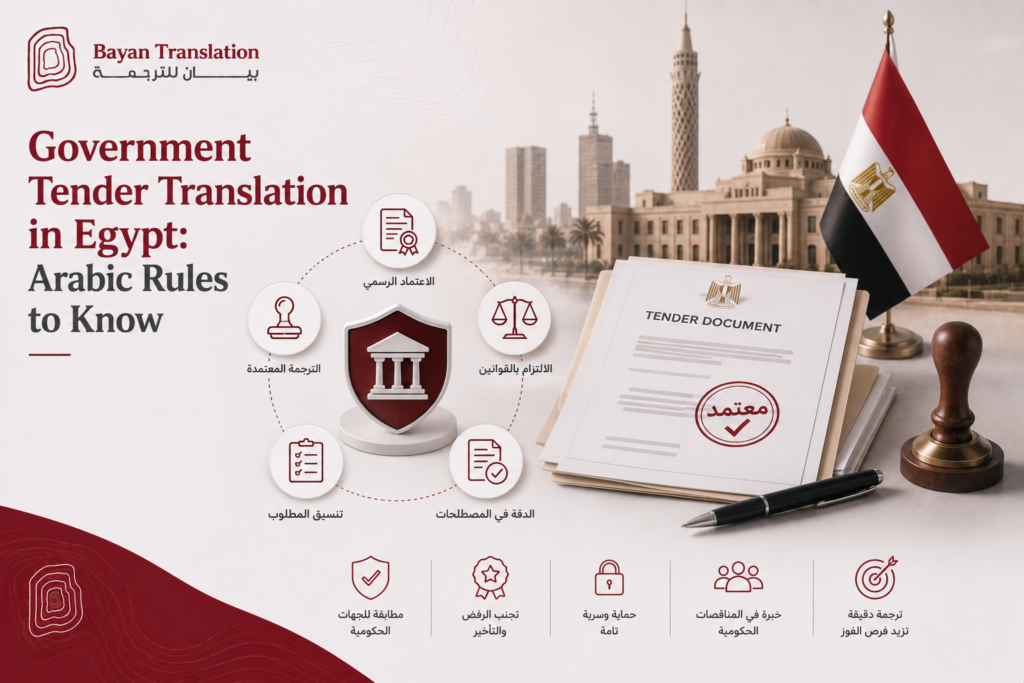
Winning a government tender in Egypt requires more than a competitive price and a capable team. Translation errors in a single document can disqualify a bid that took months to prepare. This guide covers what Egyptian procurement law requires, where translation errors most commonly occur, and how serious suppliers protect themselves.
Egyptian Procurement Law and Language Requirements
Egypt's Public Procurement Law No. 182 of 2018 and its Executive Regulations establish Arabic as the official language of government contracts and procurement documentation. This is not a preference — it is a statutory requirement. Where a foreign-language document forms part of a tender submission, a certified Arabic translation must accompany it.
The Ministry of Finance's Central Auditing Organisation and sector-specific tendering authorities (Ministry of Housing for construction, Ministry of Health for pharmaceutical tenders, etc.) each apply their own procedural requirements for translation certification. Knowing the applicable authority before preparing your submission avoids expensive last-minute corrections.
What "Certified Translation" Means in Egyptian Tendering
In the Egyptian tender context, "certified translation" typically requires the following chain of authentication:
- Sworn translator certification. The translation must be produced or countersigned by a translator sworn before an Egyptian court. Egypt's Ministry of Justice maintains a register of sworn (licensed) translators. A translation signed by an unlicensed translator, regardless of quality, is not legally recognised in formal proceedings.
- Notarisation. Many authorities require the sworn translator's signature to be notarised before an Egyptian notary public (Shahr Aqari) or a notary in the country of origin.
- Legalisation chain for foreign documents. For documents originating outside Egypt, the legalisation chain typically runs: source country notarisation → source country Ministry of Foreign Affairs apostille or stamp → Egyptian Embassy or Consulate attestation → Egyptian Ministry of Foreign Affairs counter-attestation. Egypt is not a Hague Apostille Convention member, so the full diplomatic legalisation chain applies for most document types.
- Ministry of Foreign Affairs (MFA) authentication. For documents entering Egyptian government processes, MFA authentication is the final step before a document carries full legal recognition. This step is frequently missed by suppliers unfamiliar with Egyptian administrative requirements.
Common Disqualification Errors in Tender Translation
Based on Egyptian tendering practice, these are the translation-related errors most frequently cited in tender disqualification decisions:
- Using a non-sworn translator. A highly qualified professional translator without sworn status in Egypt produces a document that is legally inadmissible for official purposes — regardless of accuracy.
- Incomplete legalisation chain. Missing any step in the chain (notarisation, embassy attestation, MFA counter-stamp) renders the document inadmissible even if every other step is complete.
- Mistranslation of financial figures. Discrepancies between translated financial statements and source documents — even where the error is clearly typographic — are grounds for disqualification. Financial translation requires translators with combined financial and legal competency.
- Incorrect legal entity terminology. Egyptian law distinguishes between various entity types (شركة مساهمة, شركة ذات مسؤولية محدودة, etc.). Mistranslating a company's legal form from a foreign-language incorporation document creates a discrepancy that can void a submission.
- Late submission caused by underestimated timeline. The full legalisation chain for a foreign document can take three to six weeks. Suppliers who begin the translation process close to a submission deadline routinely miss it.
Timeline Planning for Government Tender Translation
A realistic timeline for tender translation involving foreign-language source documents:
- Weeks 1–2: Translation production and sworn translator certification
- Week 2–3: Notarisation (source country or Egypt, depending on document origin)
- Week 3–4: Embassy or consulate attestation
- Week 4–5: Egyptian MFA counter-attestation
- Buffer: Allow one additional week for administrative delays, public holidays, and queue times at government offices
The total minimum realistic timeline is five to six weeks from commencement of translation to a fully authenticated document. Suppliers who begin this process two weeks before a submission deadline are gambling on a process outside their control.
Working With a Qualified Translation Partner for Tenders
A translation partner with specific experience in Egyptian government tendering should be able to advise on the applicable authority's specific requirements, coordinate the legalisation chain on your behalf, work with sworn translators registered with the Egyptian Ministry of Justice, and flag document-specific risks before production begins.
Bayan Translation has provided certified translation services for government and quasi-governmental tendering in Egypt and across the MENA region. Our teams coordinate sworn translator certification, notarisation, and the relevant authentication chains as part of our tender translation service.