

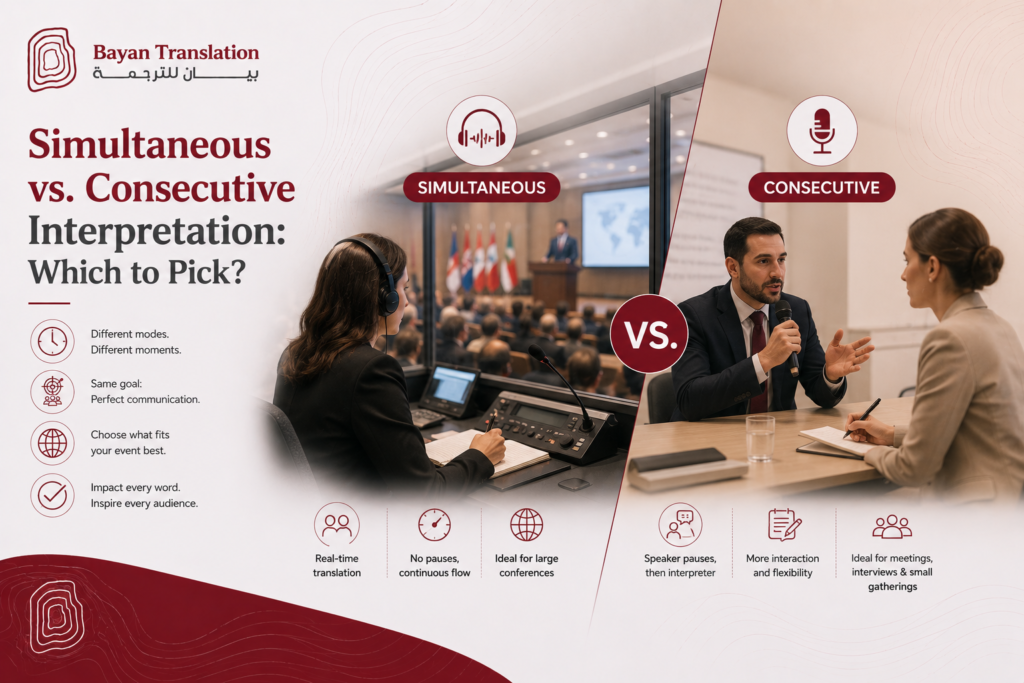
Simultaneous and consecutive interpretation are not interchangeable services. The choice between them affects every aspect of your event: budget, equipment, room setup, schedule, and the quality of communication your participants experience. This guide explains both modes, the conditions each serves, and the practical decisions that follow from choosing one over the other.
Simultaneous Interpretation: How It Works
In simultaneous interpretation, the interpreter renders speech into the target language in real time, with a lag of only a few seconds behind the speaker. The speaker does not pause. Delegates receive interpretation through headsets, allowing multilingual communication to proceed at the natural pace of the original speech.
This mode is the standard for large international conferences, diplomatic events, international arbitration hearings, and multilateral meetings with multiple language combinations. The United Nations, European Union, and most major intergovernmental bodies use simultaneous interpretation as their default mode.
The cognitive load of simultaneous interpretation is extreme. Interpreters must listen, process, translate, and speak simultaneously while managing differences in sentence structure between languages — particularly challenging between Arabic and European languages, where syntax is fundamentally different. ISO standard 4043 specifies that simultaneous interpreters work in teams of at least two, rotating every 20 to 30 minutes, to maintain accuracy and prevent fatigue-induced error.
Equipment Requirements for Simultaneous Interpretation
Simultaneous interpretation requires a physical and technical infrastructure that consecutive interpretation does not:
- Interpretation booths. ISO 4043 specifies minimum booth dimensions, sound isolation requirements, and visibility requirements. Booths must provide interpreters with clear sightlines to the speaker and any visual presentations. Temporary booths can be installed for events that lack permanent facilities.
- Interpreter consoles. Each booth requires a console with incoming audio channels, outgoing channels, volume control, and communication between booths and the technician.
- Delegate receiver units and headsets. Each delegate requires a receiver that can be tuned to their preferred language channel.
- Audio distribution system. The venue's audio system must feed interpreter booths and distribute interpretation output to delegates without interference or delay.
- Technician. A dedicated audio technician manages the system throughout the event.
Equipment hire and installation adds a material cost to simultaneous interpretation events that does not apply to consecutive interpretation. For small meetings or bilateral negotiations, this cost is rarely justified by the benefit.
Consecutive Interpretation: How It Works
In consecutive interpretation, the speaker delivers a passage — typically two to five minutes — then pauses. The interpreter then renders the speech into the target language from notes. The speaker resumes, and the cycle repeats.
This mode requires no specialised equipment. The interpreter works in the room, visible to all participants, with no booths, headsets, or audio distribution system. This makes consecutive interpretation the appropriate choice for small meetings, diplomatic dinners, bilateral negotiations, medical consultations, legal depositions, and site visits.
The accuracy potential of consecutive interpretation is high: the interpreter has heard the complete passage before rendering it, rather than interpreting mid-sentence. For precision-critical content — legal testimony, technical specifications, medical consultations — consecutive interpretation often produces more faithful output than simultaneous, at the cost of effectively doubling meeting time.
Remote Interpretation (RSI)
Remote Simultaneous Interpretation (RSI) platforms deliver simultaneous interpretation through cloud-based audio distribution rather than physical booths. Interpreters work from a hub location or from home, with interpretation delivered to participants through an event app or web browser rather than headsets.
RSI is appropriate for virtual and hybrid events where physical booth installation is impractical. Sound quality and connection stability are critical risk factors — RSI is not suitable for events where audio interruption cannot be tolerated (legal proceedings, certain governmental meetings). For online conferences and hybrid events, RSI has become a practical default where simultaneous interpretation is needed.
Interpreter Briefing: The Variable Most Often Neglected
Regardless of mode, interpretation quality is significantly influenced by the quality of preparation the interpreter receives. The briefing package for a professional interpreter should include:
- Speaker presentations, papers, or scripts in advance — ideally 48 to 72 hours before the event
- Agenda with speaker names, titles, and affiliations
- Glossary of technical, legal, or domain-specific terminology used in the event
- Acronyms and abbreviations used in the subject matter
- Names of organisations, projects, products, and individuals that will be referenced
- Any bilingual reference documents relevant to the subject matter
Interpreters who receive complete briefing materials consistently produce better output. Interpreters who receive no materials are working at a structural disadvantage that no amount of skill fully compensates for.
Choosing the Right Mode for Your Event
The practical decision framework is straightforward. Simultaneous interpretation is appropriate when: more than two language combinations are needed; the event cannot pause for interpretation; more than 20 to 30 participants need interpretation; or the event runs for more than one day. Consecutive interpretation is appropriate when: the meeting is small and bilateral or trilateral; precision is more important than pace; no equipment hire budget is available; or the setting makes booth installation impractical.
Bayan Translation provides simultaneous and consecutive interpretation services across Arabic, English, French, and a range of other language pairs. Our interpreters are briefed, accredited, and experienced in conference, legal, medical, and diplomatic settings.