
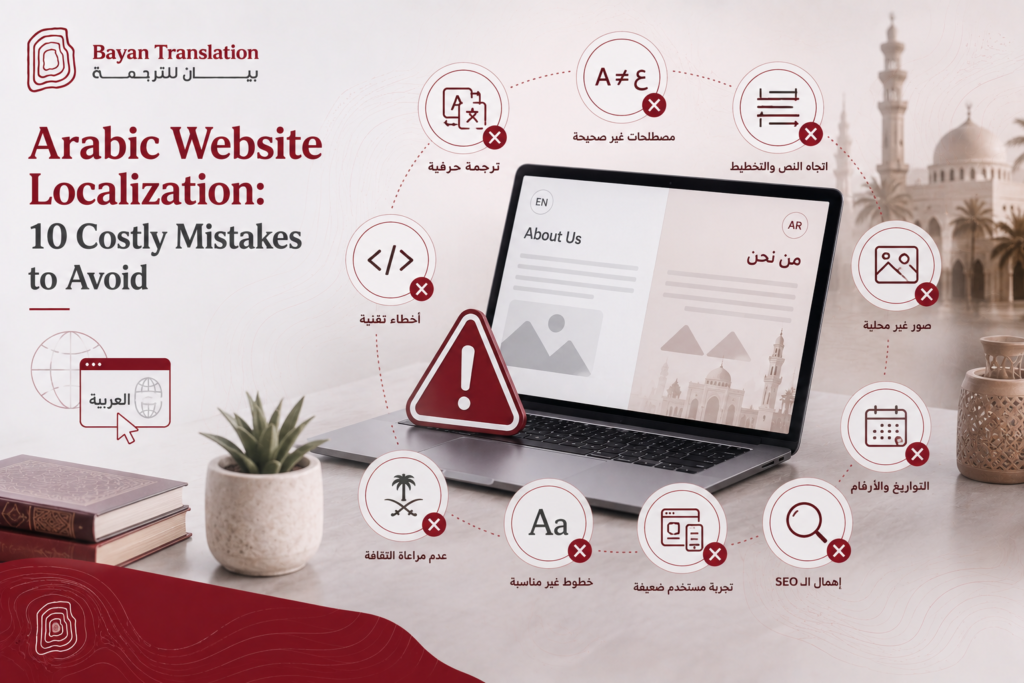
Translating a website into Arabic is not Arabic localisation. The two are often confused, and the confusion is expensive: a site that has been translated but not localised will read correctly to native Arabic speakers — and feel wrong in every other way. This guide covers the ten most consequential localisation decisions for websites targeting Arabic-speaking audiences.
1. RTL Layout Engineering Is Not a CSS Toggle
Arabic is written right-to-left. A fully localised Arabic website mirrors its layout: navigation menus align right, content flows from right to left, UI elements flip. Applying direction: rtl to a CSS stylesheet is the beginning of RTL implementation, not the end of it.
Practical issues that survive a CSS RTL switch include: icon directionality (progress arrows, breadcrumbs, carousels), form field alignment, number positioning within Arabic text, table column order, and the layout behaviour of mixed-direction content (Arabic text containing English product names, URLs, or numbers). Testing RTL implementation requires Arabic-reading QA — not a visual inspection by someone who cannot read the content.
2. Arabic Typography Requires Specific Font Selection
Arabic fonts are not interchangeable. Typeface selection affects readability, tone, and brand perception in ways that differ significantly from Latin typography. A typeface that renders well in display sizes may be illegible at body text sizes in Arabic due to kashida (letter-extension) handling and diacritic positioning. Fonts must be tested at all relevant sizes, in all relevant contexts.
Line height requirements for Arabic text differ from Latin text — Arabic characters have descenders and ascenders with different proportions. A line-height value that produces comfortable Latin text spacing will typically produce cramped Arabic text. Typography should be specified separately for the Arabic version rather than inheriting Latin values.
3. Numeral Systems Need a Deliberate Decision
Arabic-script content uses two numeral systems: Eastern Arabic numerals (٠١٢٣٤٥٦٧٨٩) and Western Arabic numerals (0123456789, the set used globally in mathematics and most Latin-script contexts). Usage varies by country and context: Eastern Arabic numerals are more common in Gulf countries and formal Egyptian publishing; Western Arabic numerals are dominant in North Africa and in digital/technical contexts across the region.
A localisation strategy must specify which numeral system to use and enforce it consistently. Mixed numeral systems within a single page or product create a perception of low quality and inconsistency.
4. Date and Calendar Formats Are Not Universal
The Gregorian calendar is the commercial and administrative standard across most Arabic-speaking markets. However, the Hijri (Islamic lunar) calendar remains relevant for religious occasions, some official contexts in Gulf states, and certain government administrative functions. Date format conventions also differ: day/month/year ordering is standard, but separator characters and month name formats vary.
An Arabic website serving Gulf business audiences may need to display both Gregorian and Hijri dates in relevant contexts — a detail that affects both content and system architecture.
5. Cultural Adaptation Goes Beyond Content Avoidance
Localisation guidance often focuses on what to avoid — imagery, references, or idioms inappropriate for a given market. Equally important, and less often discussed, is positive cultural adaptation: the imagery, social proof signals, and communication styles that resonate in specific markets.
Family and community imagery resonates broadly across Arabic-speaking markets. Imagery of professional contexts should reflect the gender dynamics and dress norms of the specific target market — which differ materially between, for example, Gulf and North African markets. Trust signals that work in English-speaking markets (five-star reviews, "as featured in" media logos) may need localisation of the specific references to carry weight with Arabic-speaking audiences.
6. Arabic Text Runs 20–30% Longer Than English
Arabic text expressing equivalent meaning is typically 20 to 30% longer than its English source. This affects every UI element where text length was a design constraint: button labels, navigation items, modal headings, error messages, tooltip text, and form labels. A UI designed for English text lengths will break visually when populated with Arabic.
Arabic localisation must be budgeted and scoped with this expansion factor in mind. Design should be tested with real Arabic copy — not placeholder text — before sign-off.
7. Arabic-First SEO Is a Separate Discipline
Arabic SEO cannot be derived from English SEO by translating keywords. The morphological complexity of Arabic, dialect variation across target markets, and different search intent patterns mean that Arabic keyword research requires native Arabic linguists with SEO expertise — not a keyword tool and a bilingual dictionary. Hreflang implementation, Arabic sitemap submission, and search engine indexing behaviour for RTL pages each require specific attention.
8. Form Fields and Input Validation Require Arabic-Aware Development
Form fields that accept Arabic text require specific development attention: input direction must flip for Arabic fields within a mixed-language form; name field validation must accept Arabic Unicode characters; character limits must account for Arabic text expansion; and error messages must be localised (not just translated) for natural Arabic phrasing.
9. Arabic Social Proof Needs Local References
Testimonials, case studies, and client logos that signal credibility to English-speaking audiences may carry no weight with Arabic-speaking audiences — because the referenced organisations are unknown in the target market. An Arabic localisation that simply translates English testimonials into Arabic produces localized text without localised credibility. Social proof for Arabic-speaking markets should reference organisations, individuals, and publications familiar to that audience.
10. Legal and Regulatory Content Requires More Than Translation
Terms of service, privacy policies, and regulatory disclosures are not language documents — they are legal documents with jurisdiction-specific requirements. An Arabic version of an English privacy policy does not automatically comply with Egyptian, Saudi, or UAE data protection requirements. Legal content requires translation by linguists with relevant legal domain knowledge, followed by legal review for the target jurisdiction.
Bayan Translation provides full Arabic website localisation services: RTL engineering review, native Arabic copywriting and transcreation, Arabic SEO, and certified legal translation for Arabic-language regulatory content. Our teams have localised websites and digital products for clients operating across the Arab world.
Request a Fee Quote Start Your Arabic Localisation Project →