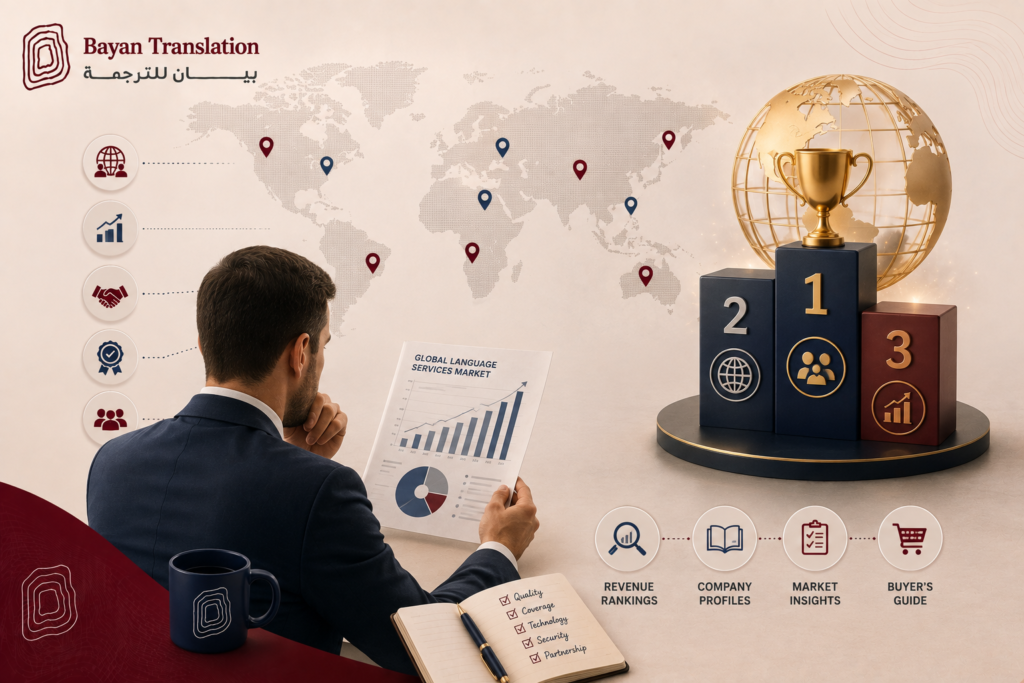
Global business runs on language. Every contract, app, and product label eventually needs to speak another tongue, and that demand has turned translation into a massive, fast-growing industry. Written translation alone made up over half of all industry revenue in 2025, and Europe still leads the world in market share.
But “biggest” doesn’t always mean “best fit” for your project. This guide breaks down how the world’s largest translation companies are ranked, what makes them different from smaller boutique agencies, and how to choose the right translation services — whether you need Arabic translation services for a Gulf market launch or certified translation for an immigration file.
Table of Contents
- How the Translation Industry Measures “Largest”
- What Makes a Translation Company Rank Among the Biggest
- Types of Providers in the Global Market
- Why Company Size Matters (and When It Doesn’t)
- A Buyer’s Guide to Choosing Translation Services
- Spotlight: Certified Translation and Arabic Translation Services
- Red Flags to Watch For
- Frequently Asked Questions
- Conclusion and Next Steps
How the Translation Industry Measures “Largest”
There’s no single stock ticker for “translation.” Instead, industry analysts like Slator and CSA Research build rankings by surveying language service providers (LSPs) directly and reviewing their annual financial reports.
These rankings usually combine three things:
- Annual revenue — the clearest sign of scale and market trust
- Headcount and linguist network size — how many translators, project managers, and engineers a company can mobilize
- Geographic footprint — how many countries and language pairs a provider actively serves
A company can be huge in revenue but narrow in language coverage, or the reverse. That’s why smart buyers look past the ranking number itself and dig into what the ranking is actually measuring.
The Market Is Growing, But Still Fragmented
One of the more surprising realities of this industry is how spread out it remains. Even the top 100 language service providers worldwide, combined, only control around 15% of total sector revenue. That means thousands of small and mid-sized agencies are still winning work, often by specializing in a niche language, industry, or document type.
Consolidation is picking up pace, though. Teleperformance’s roughly $1.5 billion acquisition of LanguageLine Solutions is a clear signal that private equity sees long-term value in scaling translation and interpretation assets. Expect more mergers as bigger players buy up specialized firms.
What Makes a Translation Company Rank Among the Biggest
The largest players in this space typically share a few traits:
- Multi-language, multi-industry capacity. They can handle legal, medical, technical, and marketing translation simultaneously, often across 50+ languages.
- Technology infrastructure. Translation management systems (TMS), machine translation engines, and AI-assisted quality checks let them process huge volumes without sacrificing turnaround time.
- Global delivery centers. Rather than one head office, they run regional hubs so a client in Cairo, Chicago, and Singapore all get the same-quality service in their own time zone.
- Compliance credentials. ISO certifications (like ISO 17100 for translation quality) and industry-specific compliance (HIPAA for healthcare, for example) are common among the top-ranked names.
Written Translation Still Dominates Revenue
Even with all the buzz around video localization, subtitling, and gaming content, plain written translation remains the largest single revenue category in the industry. That said, transcreation and multimedia localization are growing faster than any other segment, which tells you where future investment is headed.
Types of Providers in the Global Market
Not every large provider operates the same way. Broadly, the market splits into:
- Full-service LSPs — offer everything from document translation to interpretation, subtitling, and desktop publishing under one roof.
- Technology-first providers — built around AI translation platforms, with human linguists layered on top for quality control.
- Boutique and niche agencies — smaller by revenue, but often the top choice for a specific language pair, legal specialty, or regional market.
- Freelance marketplaces — connect clients directly with individual translators, usually at a lower cost but with less quality oversight.
Knowing which category a provider falls into tells you more about what to expect than their spot on a revenue chart.
Why Company Size Matters (and When It Doesn’t)
A bigger translation company usually means more capacity, more languages covered, and sturdier project management for large, ongoing programs — think a global product launch needing 40 language versions on a tight deadline.
But size isn’t everything. Here’s when a large translation company makes sense, and when it might not:
Choose a large provider when you need:
- Simultaneous translation into a large number of languages
- 24/7 delivery across time zones
- Enterprise-grade security and compliance
- Integration with your CMS or software development pipeline
Consider a smaller or specialized agency when you need:
- Deep expertise in one niche (legal, medical, patents)
- A closer, more hands-on client relationship
- Lower minimum project costs
- A specific dialect or regional variation that a generalist might miss
A Buyer’s Guide to Choosing Translation Services
Whether you’re comparing giants or boutique shops, the evaluation criteria stay largely the same.
Step 1: Define the Scope
Know your source and target languages, content type (legal, marketing, technical), volume, and deadline before you request quotes. Vague requests get vague answers.
Step 2: Check Linguist Qualifications
Ask whether translators are native speakers of the target language, subject-matter qualified, and vetted through a formal quality process — not just fluent bilinguals.
Step 3: Ask About Quality Assurance
Reputable translation services use a layered process: translation, editing, and proofreading by separate linguists (sometimes called the TEP model), plus terminology management for consistency.
Step 4: Compare Turnaround and Pricing Transparency
Get itemized quotes. Per-word, per-hour, and flat-project pricing all exist — know which model you’re being charged under and why.
Step 5: Review Data Security Practices
If you’re sending contracts, medical records, or financial data, confirm the provider’s data handling policy, NDA process, and any relevant compliance certifications.
Spotlight: Certified Translation and Arabic Translation Services
Two categories deserve special mention because they come with their own rules.
Certified Translation
Certified translation isn’t just a quality label — it’s a formal statement, usually signed by the translator or agency, attesting that the translation is a complete and accurate rendering of the original document. It’s commonly required for:
- Immigration and visa applications
- Court and legal proceedings
- Academic transcript evaluations
- Official government filings
Not every large translation company offers certification for every language pair, so confirm this upfront if your document needs to hold up with an official body.
Arabic Translation Services
Arabic translation carries its own complexity because the language varies significantly by region — Modern Standard Arabic is used for formal writing, while spoken dialects differ between the Gulf, Levant, and North Africa. A provider offering genuine Arabic translation services should be able to tell you:
- Which dialect or register your content needs
- Whether the translator has right-to-left (RTL) formatting experience for documents and websites
- How they handle industry-specific Arabic terminology, especially in legal or financial content
For businesses expanding into the Middle East, this is one area where local expertise often matters more than company size. Agencies with deep regional roots — Bayan Translation is one example — often catch dialect and cultural nuances that a purely global provider can miss.
Red Flags to Watch For
Before signing with any translation company — large or small — watch for:
- No sample translations or references available on request
- Pricing that seems drastically lower than every competitor
- Vague answers about who actually performs the translation
- No clear revision or dispute process if you’re unhappy with the output
- Machine translation output presented without disclosure
Frequently Asked Questions
Are the largest translation companies always the best choice? Not necessarily. They’re usually the safest choice for large-scale, multi-language, ongoing projects, but a smaller specialist can outperform them on niche or highly technical work.
How is “largest” measured in this industry? Mainly through self-reported annual revenue, verified against public filings where available, alongside headcount and geographic reach.
Do I need certified translation for every official document? Not always — requirements vary by country and institution. Always check with the receiving authority before ordering a certified translation.
Is AI replacing human translators at large firms? AI and machine translation are now standard tools inside most large providers, but they’re typically used to support human linguists, not replace them, especially for legal, medical, or high-visibility content.
Conclusion
The world’s largest translation companies got there by combining scale, technology, and reliable quality control across dozens of languages. But “biggest” is a starting point for your research, not the finish line. The right choice depends on your languages, your content type, your budget, and whether you need something as specific as certified translation or Arabic translation services with true regional accuracy.
Ready to Get Started? Contact Bayan Translation
Reading about the world’s biggest translation companies is useful — but what actually moves your project forward is picking a partner who understands your languages, your industry, and your deadline.
Bayan Translation brings that combination: certified translation for legal and official documents, deep expertise in Arabic translation services across regional dialects, and the project management discipline that larger LSPs are known for — without losing the personal, hands-on attention smaller agencies offer.
Whether you need a single certified document turned around quickly or an ongoing multilingual content pipeline, Bayan Translation‘s team can scope it accurately from the first conversation.
Contact Bayan Translation today to get a clear quote, a realistic timeline, and a translation partner who treats your project like it matters — because it does.